How to Choose Recycled Carpet Padding for Global Sourcing
Choosing Recycled carpet padding for global sourcing requires more than comparing recycled-content percentages. Buyers must examine material composition, compression recovery, moisture resistance, odor, and installation performance. A pad can look dense in a sample but flatten under repeated foot traffic. Small details matter.
Ray Anderson, founder of Interface and a respected sustainability leader, said, “If you can’t measure it, you can’t manage it.” His principle fits recycled carpet padding procurement. Suppliers should provide clear data on recycled fiber sources, post-consumer or post-industrial content, density, thickness, and test methods. Independent certifications can strengthen confidence, but certificates should never replace practical verification. Ask for batch records, laboratory reports, and a physical sample.
Global sourcing adds another layer of uncertainty. A humid shipping container may affect packaging, while different markets may apply different fire, emissions, or building requirements. Confirm those requirements before placing a large order. Check pallet dimensions, roll weights, lead times, and replacement procedures. A factory’s attractive price may become expensive after freight, inspection, delays, and rejected goods.
Use your feet, too.
Place sample pieces beneath carpet in a busy corridor. Walk across them daily. Check whether edges curl, seams shift, or the cushioning becomes uneven. This is not a perfect laboratory test. It is still useful. Recycled materials can vary between batches, and buyers sometimes trust polished documents too quickly. A responsible sourcing decision combines verified evidence, supplier experience, and honest recognition of what remains unknown. This guide explains how to compare options without treating sustainability claims as automatic proof of quality.
Understanding Recycled Carpet Padding and Its Main Materials
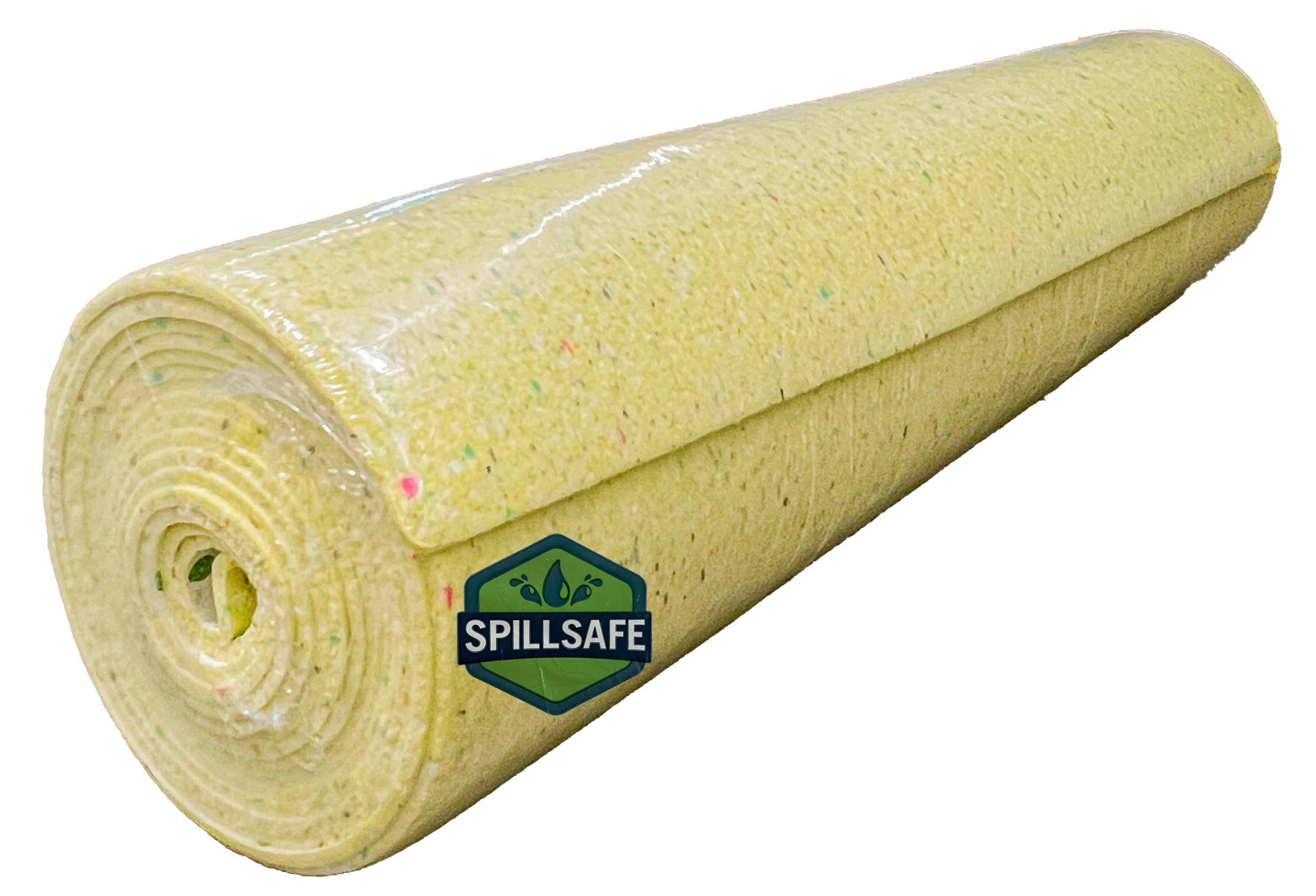
Recycled carpet padding is not one uniform product. It is a cushioning layer, but its structure depends on the recovered material. Common options include recycled PET fibers, rebonded polyurethane foam, recycled rubber, and reclaimed textile fibers. PET usually offers resilient support and stable thickness. PU foam is lighter and often easier to compress. Rubber feels dense, while textile blends can vary widely. These differences affect comfort, freight weight, moisture behavior, and service life.
For global sourcing, ask suppliers to state the recycled content by mass. Separate pre-consumer and post-consumer content in the documentation. Also record density, thickness, bonding method, and compression recovery. A sample can feel excellent on day one. Then it may lose height after repeated loading. Test several pieces after storage, bending, and repeated compression. Ask for current reports covering odor, emissions, moisture, and fire performance. Exact requirements depend on the installation and destination.
Traceability makes the material easier to trust. Batch numbers, production dates, declarations, and test records should match. During inspection, check cut edges for loose fibers or uneven bonding. Notice any oily smell. No recycled stream is perfectly uniform. Higher recycled content is not automatically better. Inconsistent feedstock can reduce durability. I have seen precise specifications with vague tolerances. That gap deserves attention. Compare three production lots before approving a larger order. Good padding should perform consistently, not merely sound environmentally responsible.
Assessing Cushion Performance, Safety, and Environmental Attributes
When choosing recycled carpet padding for global sourcing, assess cushion performance before discussing sustainability claims. Measure thickness, density, compression resistance, and recovery after repeated loading. A sample may feel soft in a showroom but flatten under office chairs or heavy cabinets. Request test data for dimensional stability, moisture resistance, and acoustic performance. Compare results under realistic temperatures, since a warehouse in a humid region can expose weaknesses quickly.
Safety requires equal attention. Ask for current reports on indoor emissions, restricted substances, odor, and fire behavior. Product documentation should identify testing methods, laboratory details, and production dates. Recycled fibers, foam, or rubber can vary between batches. That variation deserves monitoring. Do not treat one successful sample as permanent proof. A small batch check can reveal unusual odor, uneven density, or weak edges.
Environmental attributes need evidence, not attractive wording. Verify recycled content through supplier records, mass-balance calculations, or recognized third-party assessments. Examine manufacturing energy, water use, packaging, expected service life, and end-of-life options. Transportation also matters; dense padding may increase shipping emissions despite recycled inputs. I have found that simple scorecards improve supplier comparisons, but they can hide trade-offs. A low-carbon product may have shorter recovery life. A durable product may be harder to recycle. Recheck the priorities with installers, building users, and local compliance teams before placing a large order.
Matching Padding Specifications to Carpet Type and Installation Needs
Choosing recycled carpet padding begins with the carpet, not the lowest purchase price. In global sourcing, request density, thickness, roll width, compression recovery, and recycled-content documentation. Dense padding supports heavy traffic and reduces premature matting. However, excessive thickness can make seams visible or cause doors to drag. Check the carpet manufacturer’s installation range before approving samples. I have seen attractive samples fail when installers could not stretch the carpet evenly. That lesson still matters.
For broadloom carpet, select padding with stable dimensions and controlled compression. It should support stretching without shifting under the carpet. Low-pile commercial carpet often needs a firmer, thinner pad. Plush residential carpet may accept more cushioning, but too much movement can damage the backing. Carpet tile usually requires a firm, low-profile solution, especially over smooth concrete. Some tiles are installed directly, so an added pad may be unsuitable. Never assume one specification fits every room.
Installation conditions also change the specification. Concrete floors may require moisture testing before padding arrives. Uneven subfloors need correction, not a softer pad to hide defects. For stairs, use firm padding that follows the nosing securely. Ask suppliers for sample rolls, compression data, odor information, and independent test reports. Confirm fire, chemical, and building requirements in the destination market. Recycled fiber quality can vary between batches. Keep a retained sample and inspect density after delivery. This process is slower, but it exposes weak assumptions before installation.
How to Choose Recycled Carpet Padding for Global Sourcing
Matching padding specifications to carpet type and installation needs
Evaluating Global Suppliers, Certifications, and Manufacturing Standards
How to Choose Recycled Carpet Padding for Global Sourcing
Recycled carpet padding needs more than a recycled-content claim. A supplier should identify feedstock, processing sites, and batch controls. The U.S. EPA reported approximately 3.4 million tons of carpet and rugs entered the municipal waste stream in 2018. This figure shows why material recovery deserves careful verification, not optimistic language.
Ask suppliers for chain-of-custody records, test reports, and production samples. The Global Recycled Standard and Recycled Claim Standard can verify recycled inputs and material tracking. ISO 14021 also supports accurate environmental claims. These documents should match purchase orders and shipment records. Small discrepancies matter. A recycled rubber pad should show polymer composition, density, thickness, odor performance, and compression recovery. Test results should include laboratory methods and test dates.
Manufacturing standards reveal practical reliability. ISO 9001 procedures can support consistent inspection, while ISO 14001 indicates a structured environmental management system. Neither standard guarantees a superior product. That is easy to forget. Request recent audit findings, corrective-action records, and evidence of worker safety controls. The OECD Due Diligence Guidance recommends risk-based supplier assessment across global supply chains. Use that principle when comparing factories in different regions. Local conditions can change energy sources, wastewater controls, and transport impacts. Textile Exchange market reports also show recycled fibers remain a limited share of total global fiber production, so availability claims deserve scrutiny. Require independent verification before approving large volumes. Supplier visits help, but they are not perfect. A quiet factory day can hide seasonal problems.
| Evaluation Dimension | Data Point or Benchmark | Recommended Requirement | Verification Evidence | Why It Matters in Global Sourcing |
|---|---|---|---|---|
| Recycled Feedstock | Primary material source | Identify whether the padding is made from post-consumer textile fibers, post-industrial fibers, recycled PET, recycled polyurethane foam, or a blended feedstock. | Material declaration, bill of materials, recycled-input flow chart, and supplier traceability records. | Different feedstocks provide different levels of cushioning, dimensional stability, moisture resistance, and end-of-life recyclability. |
| Recycled Content | Declared recycled percentage | Require a product-specific percentage by total product weight. Separate post-consumer content from pre-consumer or post-industrial content. | Independent transaction certificates, mass-balance records, production records, and third-party chain-of-custody documentation. | Prevents unsupported environmental claims and allows accurate comparison between products from different regions. |
| Certification | Global Recycled Standard (GRS) | Use when recycled-content verification, chain of custody, social requirements, chemical controls, and environmental processing requirements are needed. GRS certification generally requires at least 20% recycled material at the product level. | Valid scope certificate, valid transaction certificate, certified facility list, and product-specific certificate. | Provides a recognized framework for verifying recycled inputs and responsible processing across international supply chains. |
| Certification | Recycled Claim Standard (RCS) | Use when the primary requirement is verification and traceability of recycled content. RCS generally recognizes products containing at least 5% recycled material. | Current scope certificate, transaction certificate, and documented chain of custody. | Offers a more focused recycled-content verification route when broader GRS requirements are not required. |
| Environmental Management | ISO 14001 | Prefer manufacturing sites operating a certified environmental management system covering waste, energy, water, emissions, and legal compliance. | Current ISO 14001 certificate, certification body details, audit scope, and corrective-action records. | Helps evaluate whether environmental controls are managed systematically rather than through isolated product claims. |
| Quality Management | ISO 9001 | Prefer facilities with documented quality controls for incoming recycled feedstock, production processes, testing, nonconformities, and corrective actions. | Current ISO 9001 certificate, process-control plan, inspection records, and calibration records. | Reduces variation in thickness, density, compression performance, and roll or sheet dimensions across shipments. |
| Chemical Safety | Restricted substances control | Require compliance with destination-market chemical regulations, including applicable REACH restrictions and customer-specific restricted-substance lists. | Recent laboratory test reports, chemical inventory, safety data sheets, and supplier declarations. | Recycled feedstocks can carry legacy chemicals or contaminants; testing should be based on the actual material and destination market. |
| Indoor Air Quality | VOC and emissions performance | Specify a recognized low-emission test protocol suitable for flooring products and require limits appropriate to the intended market. | Independent chamber-test report identifying the exact construction, adhesives, backing, and test method. | Padding can contribute to indoor emissions, especially when combined with carpet adhesives and tightly sealed interiors. |
| Performance | Thickness and density | Set a product-specific tolerance for thickness and density rather than comparing recycled content alone. Confirm results using the same test method for all quotations. | Pre-shipment inspection report, laboratory report, production specification, and retained sample. | Thickness and density influence comfort, appearance retention, acoustic performance, and compatibility with the carpet system. |
| Performance | Compression behavior | Evaluate compression force deflection, thickness loss, and recovery after repeated loading. For polyurethane foam, ISO 3386-1 is a commonly used compression-stress test method. | Laboratory test report showing test method, specimen conditioning, load, recovery period, and results. | Reliable compression performance helps prevent premature flattening in high-traffic areas. |
| Dimensional Stability | Expansion, shrinkage, and curling | Require dimensional-stability testing under temperature and humidity conditions representative of the installation market. | Test report, climate-conditioning records, installation instructions, and batch inspection data. | Global transport and seasonal humidity changes can cause fit problems, wrinkling, or installation failure. |
| Fire Performance | Reaction-to-fire classification | Specify the required classification according to the destination market and complete floor assembly. EN 13501-1 is used for European reaction-to-fire classification; ASTM E648 is commonly used for critical radiant flux testing of floor-covering systems in North America. | Independent fire-test report for the complete approved carpet-and-underlay combination, where required. | Fire performance depends on the full floor assembly, not only on the recycled padding material. |
| Acoustic Performance | Impact and airborne sound performance | Request impact-sound and airborne-sound data using a test method relevant to the building type and installation system. | Acoustic laboratory report, installation configuration, carpet construction, and adhesive details. | Padding can improve comfort and acoustics, but published results are meaningful only when the full assembly is clearly defined. |
| Manufacturing Controls | Batch consistency | Require lot identification, incoming-material inspection, controlled blending, process records, and retained samples for every production batch. | Batch number, certificate of analysis, inspection checklist, production log, and sample-retention procedure. | Recycled materials may vary in color, fiber length, density, and contamination level; documented controls reduce shipment-to-shipment variation. |
| Social Compliance | Worker and workplace controls | Assess working hours, wages, forced-labor risk, child-labor prevention, health and safety, and grievance procedures against applicable laws and buyer requirements. | Independent social-audit report, corrective-action plan, worker interviews, and legal-compliance records. | Responsible sourcing requires social-risk management in addition to recycled-content verification. |
| Supplier Audit | Audit readiness | Require access to production areas, testing facilities, subcontractor information, environmental records, and traceability documentation. | Completed supplier questionnaire, on-site audit, remote document review, and corrective-action follow-up. | Audit transparency is a practical indicator of supply-chain maturity and claim reliability. |
| Logistics | Export and packaging suitability | Confirm roll or sheet dimensions, compressed-packaging limits, moisture protection, pallet configuration, container utilization, and export documentation. | Packing specification, loading plan, moisture-control procedure, carton or wrapping test, and shipping records. | Efficient packaging reduces freight cost and damage risk while supporting consistent installation dimensions. |
| Traceability | Chain of custody | Maintain traceability from recycled input through processing, conversion, packing, and shipment. Do not accept a certificate that does not cover the actual product or transaction. | Purchase records, production batches, warehouse records, shipment documents, scope certificate, and transaction certificate. | Traceability links the environmental claim to the goods actually purchased and imported. |
| Commercial Evaluation | Total landed cost | Compare product price, certification cost, testing, packaging, inland transport, ocean or air freight, duties, insurance, inspection, and expected waste. | Itemized quotation, Incoterms, freight estimate, tariff classification, packaging dimensions, and quality-risk allowance. | The lowest ex-factory price may not produce the lowest total cost after logistics, compliance, and quality risks are included. |
| Recommended Scoring | Supplier evaluation weight | Product performance: 25% Traceability: 20% Quality systems: 15% Compliance: 15% Cost and logistics: 15% Capacity and continuity: 10% | Score each requirement from 0 to 5, attach evidence, and apply a minimum pass threshold before commercial negotiation. | A weighted score prevents recycled content or price from overshadowing performance, compliance, and supply continuity. |

Planning Costs, Logistics, Quality Checks, and Sustainable Procurement
Global sourcing recycled carpet padding starts with a realistic landed-cost plan. Include material price, compression packaging, inland transport, ocean freight, duties, taxes, and inspection fees. Request quotes using the same delivery terms. Small wording differences can distort comparisons. A trial shipment may reveal unexpected port, storage, or repacking charges. I have seen attractive factory prices lose their advantage after local delivery costs were added.
Logistics needs equal attention. Confirm roll dimensions, pallet limits, container loading plans, and moisture protection before ordering. Recycled padding can arrive compressed, damp, or misshapen after long transit. Ask suppliers for production lead times and a documented recovery period after unpacking. Keep buffer time for port delays. It feels wasteful. Sometimes it prevents expensive installation disruption. A written packing specification is more dependable than a friendly promise.
Quality checks should combine documents with physical testing. Verify recycled-content evidence, fiber composition, density, thickness, compression recovery, odor, and dimensional stability. Use an independent laboratory when the project risk justifies it. Check flammability and emissions requirements for the destination market. Samples should be tested after storage, not only when fresh. Sustainable procurement also requires traceability from recovered material to finished padding, plus practical wastewater and waste-handling controls. Avoid judging sustainability from recycled-content percentages alone. My own review process can miss weak subcontractor records, so supplier audits and corrective-action deadlines matter. Buy only the performance you need, because excessive thickness can increase freight, waste, and installation problems.
Related Posts
-
Top Benefits of Using Recycled Carpet Padding for Your Home?
-
How to Choose Marine Upholstery Foam for Your Boat Needs?
-
Top 10 Benefits of Packaging Foam Protection for Global Buyers?
-
China Top Sleep Quality Optimization Techniques for Better Rest?
-
2026 Top Pet Bed Foam Types for Global Buyers?
-
China Top 10 Packaging Foam Protection Manufacturers?
Let's Work Together
The most innovative products come from the most innovative people - and for over 55 years our team has been propelled by curiosity and a steadfast dedication to inventing and creating the best foam formulations for our customers.