

Where to Find China Top A4 Label Manufacturers?
Finding China’s top A4 Label manufacturers requires more than comparing product photos and quoted prices. China’s manufacturing base is broad, but quality varies between factories, trading companies, and specialized converters. Smithers’ “The Future of Labels and Release Liners to 2028” reports continued growth in global label demand, supported by e-commerce, logistics, and short-run printing. Mordor Intelligence also identifies Asia-Pacific as a leading regional market. These findings explain the opportunity, but they do not rank individual A4 Label suppliers.
A practical search can begin with Made-in-China, Alibaba, Global Sources, and exhibitor lists from the China International Import Expo. Canton Fair records may also reveal established paper-product exporters. Look for manufacturers showing real production details: coating lines, sheet-cutting equipment, adhesive specifications, and monthly capacity. Ask for samples with identical dimensions, corner accuracy, release-paper quality, and printer compatibility. Tiny details matter.
Do not trust “top manufacturer” claims too quickly. A polished website proves little. Request factory videos, recent test reports, export references, and a clear quality-control process. ISO 9001 certification can support credibility, but it does not replace product testing. Check adhesive performance under humidity, temperature changes, and repeated printer feeding. Results may differ from the sample. That is worth admitting. A supplier with transparent limitations may be safer than one promising perfection. Experienced buyers should compare total landed cost, packaging protection, lead time, communication speed, and after-sales responsibility before selecting a long-term China A4 Label partner.
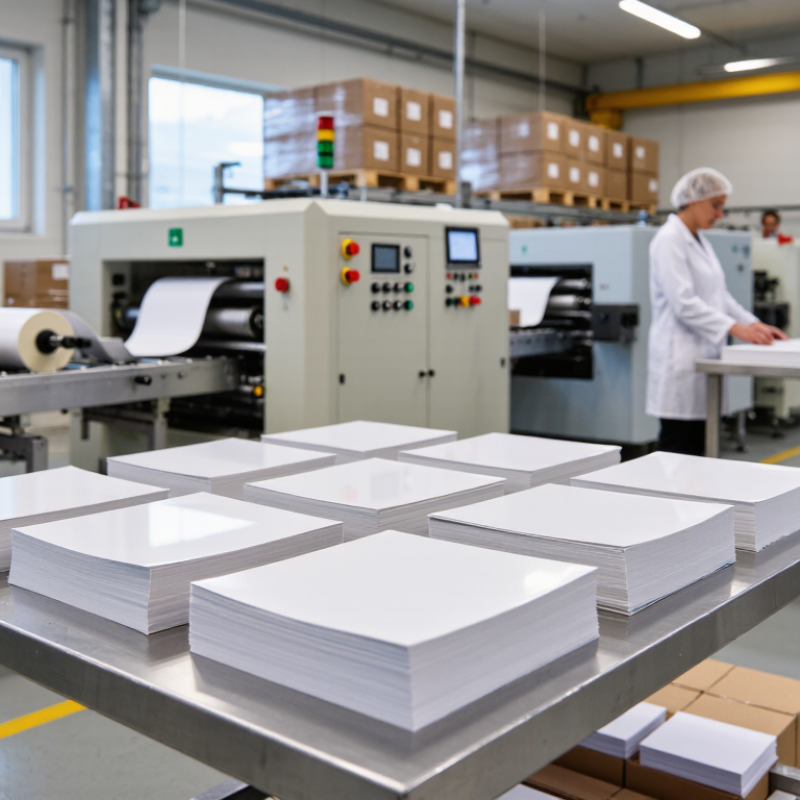
Understanding the China A4 Label Manufacturing Market
China’s A4 label manufacturing market serves offices, schools, warehouses, retailers, and logistics companies. Most suppliers produce standard adhesive sheets, removable labels, recycled options, and custom formats. Production is concentrated in established printing regions with strong paper, adhesive, and packaging supply chains. This helps manufacturers offer flexible quantities and shorter lead times.
A reliable supplier should explain its paper grade, adhesive performance, sheet accuracy, and packaging method. Ask for samples before discussing large orders. Check whether the labels feed smoothly through common printers. Small alignment errors can waste hundreds of sheets. Factory audits can also reveal storage conditions, inspection procedures, and moisture control. These details often matter more than a low quotation. However, supplier websites may show incomplete information, so independent verification remains necessary.
Tips: Compare at least three manufacturers. Request samples from the same specification. Test printing, peeling, and storage stability. Confirm production capacity, inspection records, and export experience. Ask how defects are handled. A clear answer is valuable. Do not rely only on attractive photos or broad claims. Some buyers overlook packaging quality, yet curled sheets or damaged corners can affect machine feeding. Pricing may change with paper costs, adhesive choices, order volume, and delivery terms. Therefore, record every technical requirement in writing. Dialogue can be imperfect, especially across languages, but precise specifications reduce avoidable misunderstandings.
Defining Quality and Compliance Requirements for A4 Labels
Where to Find China Top A4 Label Manufacturers?
Defining quality and compliance requirements should come before comparing Chinese A4 label manufacturers. A4 sheets must maintain the correct 210 × 297 mm format, with clean edges and stable dimensions. Request tolerance data, not only attractive samples. A practical specification should cover paper weight, brightness, adhesive strength, liner release, and printing compatibility. Test labels in your actual laser or inkjet printer. A sample that feeds smoothly once may fail after several hundred sheets.
Compliance depends on the label’s application and destination market. Ask for material declarations, safety data sheets, batch traceability, and relevant test reports. For labels used with packaging, check ink durability, odor, moisture resistance, and possible substance restrictions. Requirements can differ between ordinary office labels, warehouse labels, and labels touching regulated products. A reliable manufacturer should explain these differences clearly. Vague promises are a warning sign.
Keep records. Measure label dimensions, corner lift, adhesive residue, and barcode readability across multiple batches. An independent laboratory can verify critical results when shipment risks are high. In production reviews, I have seen buyers approve a perfect first sample and overlook liner curl. That mistake was expensive. Quality is not just appearance; it is repeatable performance under real conditions. Some specifications may need revision after testing, and that is normal. Better to adjust early than defend an assumption later.
Finding Reliable A4 Label Manufacturers in China
Where to Find China Top A4 Label Manufacturers?
Finding reliable A4 label manufacturers in China requires more than comparing online prices. Experienced buyers usually begin with verified industrial directories, trade exhibitions, and supplier referrals. A manufacturer should show a clear factory address, production equipment, and quality control process. Request recent photos of coating lines, slitting machines, and packing areas. Small details matter.
Ask for physical samples before discussing large orders. Check the label size, paper thickness, adhesive strength, cutting accuracy, and sheet flatness. Test the labels on your actual printers and envelopes. A4 sheets that curl after printing can create costly delays. Confirm whether the supplier can control moisture, dust, and uneven edges during production.
Reliable manufacturers should provide material specifications, inspection records, and reasonable delivery terms. Discuss carton strength, inner packaging, and batch identification in writing. Independent audits can add confidence, but they do not replace sample testing. A factory may pass one inspection and still miss a detail later. That is where regular pre-shipment checks become useful. Do not trust polished photographs alone. Look for consistent answers, traceable documents, and practical communication. A careful supplier may admit a limitation instead of promising everything. That honesty is often more valuable than a low quotation.
Comparing Suppliers, Prices, Samples, and Production Capabilities
Finding reliable China-based A4 label manufacturers requires more than comparing online quotations. Experienced buyers should verify paper grade, adhesive behavior, sheet accuracy, and packaging protection. Ask for technical data, factory photographs, audit records, and recent export references. A clear supplier profile reduces avoidable surprises. However, polished documents do not prove consistent production.
Price comparisons should use identical specifications: label size, material, adhesive type, sheets per pack, carton quantity, and order volume. A low quote may exclude tooling, sampling, inspection, or freight preparation. Request samples from regular production, not only specially prepared pieces. Test them on your actual printer and storage conditions. Check feeding, edge lift, curl, print sharpness, and residue after removal. Small tests matter.
Production capability includes converting equipment, quality controls, lead times, and responses to custom requirements. Ask for monthly capacity, typical order quantities, production scheduling, and defect-handling procedures. Suppliers should explain how they control die-cutting alignment and moisture during packing. A video call can reveal workflow, but it cannot replace independent inspection. I have seen buyers overvalue factory size and undervalue communication speed. That judgment can fail. Keep written specifications and approve a pre-production sample before ordering at scale.
Where to Find China’s Top A4 Label Manufacturers?
Benchmark comparison of typical supplier models for A4 self-adhesive label production, including pricing, sampling, minimum order quantities, and lead times.
Digital printing is generally suitable for customized samples and smaller orders, while flexographic production usually offers lower unit prices at high volumes. Offset and die-cut production provides a practical balance for coated paper, laser-printable, and multi-format A4 label sheets. Figures are indicative market benchmark midpoints; final prices depend on material, adhesive, printing coverage, packaging, order quantity, and shipping terms.
Verifying and Selecting the Best Manufacturing Partner
Finding China’s top A4 label manufacturers requires more than comparing online prices. A reliable partner should provide traceable materials, stable production, and clear communication. Ask for the factory address, business license, production capacity, and quality certificates. Verify each document independently. Do not rely on polished photographs alone.
Request samples made with the same adhesive, paper weight, liner, and core size as your order. Test them in your actual printers and storage conditions. Check feeding performance, edge cutting, print sharpness, and adhesive residue. Samples reveal more. Ask for evidence. A capable manufacturer should explain tolerances, inspection points, and corrective actions without avoiding technical questions.
A factory visit can expose details that emails hide. Observe material storage, humidity control, packaging, and batch identification. Review inspection records for surface defects, size variation, and carton damage. Discuss lead times using a written production schedule, not a promise. Payment terms, replacement policies, and change-control procedures also deserve careful review. During supplier selection, compare total risk rather than the lowest quotation. One inexpensive batch may become costly after reprinting or delayed delivery. I have seen purchasing teams focus heavily on price and overlook liner curl. That mistake is easy to repeat. A better evaluation combines verified documents, physical testing, production transparency, and responsive after-sales support. Clear records matter.
Where to Find China Top A4 Label Manufacturers? - Verifying and Selecting the Best Manufacturing Partner
| Evaluation Dimension | Relevant A4 Label Requirement | Evidence to Request | Practical Verification Method | Warning Sign |
|---|---|---|---|---|
| A4 dimensional accuracy | Finished sheets should follow the international A4 format: 210 × 297 mm. | Technical drawing, tolerance specification, and recent inspection report. | Measure samples with a calibrated ruler or digital caliper at several points and check squareness. | Inconsistent sheet size, skewed edges, or unclear dimensional tolerances. |
| Face-stock selection | Common options include uncoated paper, coated paper, synthetic film, and thermal materials, selected according to printing and use conditions. | Material data sheet stating basis weight or thickness, surface finish, opacity, and intended application. | Compare the supplied sample with the approved specification for stiffness, opacity, smoothness, and print receptivity. | Material description uses only general terms such as “premium paper” without measurable properties. |
| Adhesive performance | Adhesive type should match the substrate, temperature range, humidity, removability, and expected service life. | Adhesive technical data sheet and peel, loop-tack, or shear test results using defined conditions. | Test labels on the actual application surface after conditioning under the intended temperature and humidity. | No test method, no application-temperature range, or adhesive failure during normal handling. |
| Printer and feeder compatibility | The sheet must feed consistently through the target printer without curling, double-feeding, toner lifting, or ink smearing. | Printer compatibility statement, recommended media settings, and machine trial results. | Run a representative batch through the intended printer and inspect feeding, registration, drying, and label release. | The supplier refuses a machine trial or provides samples that differ from the proposed production material. |
| Print quality control | Critical factors include color consistency, registration, solid coverage, fine text, and barcode readability. | Color-control procedure, inspection standard, approved proof, and barcode test report. | Use a spectrophotometer for color evaluation where required and verify barcodes according to ISO/IEC 15416 or ISO/IEC 15415. | Visual-only inspection with no retained samples, measurement records, or acceptance criteria. |
| Die-cutting and matrix control | Labels should release cleanly from the liner while remaining securely attached during transport and printing. | Die specification, liner specification, cut-depth standard, and waste-removal inspection records. | Check label spacing, edge lifting, liner cuts, matrix removal, and dispensing performance across the sheet. | Irregular gaps, damaged liners, difficult label release, or visible adhesive contamination. |
| Material compliance | Materials may need to meet applicable chemical, recycling, food-contact, or market-specific requirements. | Recent third-party test reports, declarations of conformity, safety data, and traceable material records. | Confirm that reports identify the same material, adhesive, and construction as the production specification. | Expired reports, incomplete product identification, or unsupported compliance claims. |
| Quality management system | A documented quality system should control incoming materials, production inspections, nonconformities, and corrective actions. | Valid ISO 9001 certificate, process flow chart, inspection plan, and corrective-action records. | Verify certificate validity and scope through the issuing certification body or an appropriate accreditation database. | Certificate scope does not cover the manufacturing site or the relevant production activity. |
| Production capacity | Capacity should support the required sheet size, adhesive construction, print process, finishing method, and delivery schedule. | Equipment list, production-flow description, capacity calculation, and recent production schedule. | Review the actual factory process and compare quoted output with equipment speed, working shifts, and quality checkpoints. | Capacity is stated as a large monthly number without equipment, shift, or product assumptions. |
| Sampling and pilot order | Samples should represent the proposed production materials, construction, artwork, packaging, and finishing process. | Pre-production sample approval form, sample identification, and retained reference sample. | Approve a signed or digitally documented sample before placing a larger production order. | Free samples use substitute materials or cannot be traced to a production specification. |
| Packaging and shipment protection | Flat sheets need protection from moisture, pressure, dust, edge damage, and temperature changes during transport. | Packing specification, carton markings, pallet plan, moisture protection, and shipping inspection checklist. | Inspect carton strength, internal support, pallet stability, and package condition after a transport simulation or delivery. | Loose packing, missing lot identification, crushed corners, or moisture exposure. |
| Traceability and after-sales response | Each shipment should be traceable to raw materials, production date, inspection results, and shipment records. | Lot-number system, certificate of analysis where applicable, complaint procedure, and response-time commitment. | Conduct a mock complaint and ask the supplier to identify affected lots and corrective actions. | No lot code, incomplete records, or verbal-only quality commitments. |
| Commercial and logistics fit | The quotation should clearly define specification, quantity, tooling, packaging, lead time, shipping terms, and payment conditions. | Itemized quotation, production lead-time plan, shipping terms, and written change-control procedure. | Compare suppliers using the same specification and calculate total landed cost rather than unit price alone. | Unclear inclusions, changing specifications, unexplained surcharges, or unrealistic delivery promises. |
Recommended selection approach: verify documentation first, compare representative samples, complete a production trial, and approve the supplier only after quality, capacity, compliance, and delivery performance meet the agreed requirements.
Article Source:
Let's Work Together
The most innovative products come from the most innovative people - and for over 55 years our team has been propelled by curiosity and a steadfast dedication to inventing and creating the best foam formulations for our customers.