
Top 10 PU Leather Material Types for Global Buyers

Choosing the right PU Leather Material can shape product quality, cost, and customer trust across international markets. Global buyers often compare appearance, flexibility, abrasion resistance, odor, thickness, and surface finish before approving a supplier. A soft matte material may suit handbags, while a stronger embossed grade may perform better on furniture or automotive interiors. Small details matter. Grain depth, backing fabric, and edge behavior can change the final result.

This guide introduces ten PU leather material types commonly considered by global buyers. It connects material structure with practical uses, purchasing concerns, and quality checks. Experienced sourcing teams usually request samples, technical data sheets, and test reports before placing large orders. They also inspect color consistency under different lighting. A factory sample can look excellent, yet production batches may vary slightly. That risk deserves attention.

No single option wins every project. Buyers should balance design goals with climate, handling conditions, production methods, and target pricing. Water-based, solvent-based, microfiber-backed, recycled-content, and specialty embossed materials may offer different advantages. However, marketing terms can be unclear without supporting documentation. Verify composition, thickness tolerance, colorfastness, tensile strength, and applicable safety requirements with reliable suppliers. Some recommendations may need adjustment for regional regulations or end-use conditions. That is normal. Careful comparison, independent testing, and clear communication remain more dependable than attractive photographs alone.
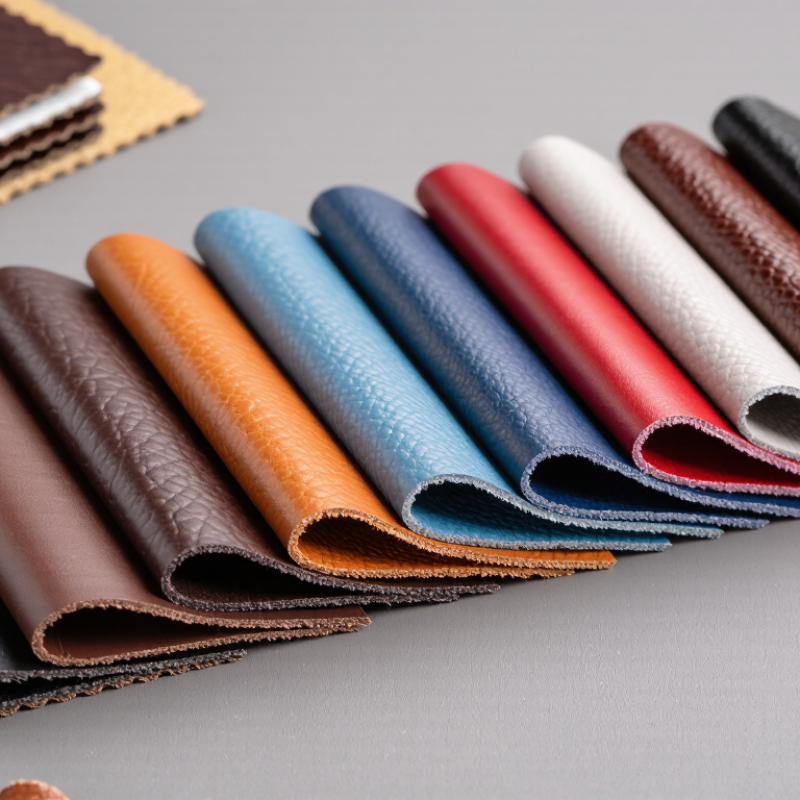
Top 10 PU Leather Material Types for Global Buyers

Defining PU Leather and Its Role in Global Material Markets

PU leather is a composite material. Manufacturers apply polyurethane to a textile backing, creating a leather-like surface without using animal hide. Its feel depends on resin chemistry, backing fiber, embossing depth, and surface finishing.

Common market types include standard coated PU, waterborne PU, microfiber PU, embossed PU, and nubuck-look PU. Other options include metallic PU, perforated PU, recycled-content PU, bio-based PU, and coated mesh PU. These ten types serve different design, durability, and price requirements.

Global buyers use PU leather in furniture, footwear, bags, automotive interiors, and upholstery. It offers consistent color, scalable production, and easier specification than many natural materials.

However, “eco-friendly” is not automatic. Buyers should verify coating thickness, abrasion results, hydrolysis resistance, odor, tensile strength, and backing composition.

In my sourcing experience, clear test reports prevent costly mismatches between a sample and bulk production. A soft sample may still fail under heat, flexing, or repeated cleaning. That distinction matters.

PU can look premium, yet feel slightly synthetic. This limitation deserves honest evaluation.

Tips: Request a technical data sheet and physical sample together. Test the material under expected humidity, friction, and cleaning conditions. Check recycled or bio-based claims through reliable documentation, not attractive wording alone. Also compare color consistency across production lots, because small shade changes can affect finished goods.

Ten Major PU Leather Types and Their Distinctive Properties

Top 10 PU Leather Material Types for Global Buyers

Ten Major PU Leather Types and Their Distinctive Properties

PU leather varies sharply in feel, durability, breathability, and environmental profile. Solvent-based PU offers strong adhesion and a smooth finish. Water-based PU usually reduces volatile solvent use, but it may require stricter drying control. Microfiber PU has a dense fiber structure, good tear resistance, and a suede-like handfeel. Silicone-coated PU resists water, stains, and temperature changes. Bio-based PU replaces part of its fossil-based content with plant-derived inputs. The percentage is often modest, so buyers should verify test reports.

Embossed PU reproduces grain patterns and hides minor surface defects. Laminated PU combines a textile backing with a protective film, supporting bags, upholstery, and footwear. Perforated PU improves airflow through small, regular openings.

Suede-effect PU feels soft and warm, but its nap can flatten under heavy friction. Stretch PU contains elastic components, making it suitable for fitted furniture and flexible apparel. Small details matter.

Market assessments from Grand View Research and Fortune Business Insights both forecast continued growth in synthetic leather demand, driven by automotive, furniture, and footwear applications. Their figures differ because each report uses different product boundaries. That is worth remembering.

In practical sourcing, buyers should compare abrasion cycles, hydrolysis resistance, coating thickness, colorfastness, and restricted-substance declarations. A beautiful sample can still fail after humid storage. I have seen finish uniformity look excellent at delivery, then weaken during folding tests. Independent laboratory verification remains essential.

How PU Leather Types Differ in Structure, Finish, and Performance

Top 10 PU Leather Material Types for Global Buyers

PU leather differs mainly through its backing, coating, surface treatment, and curing method. Common types include fabric-backed PU, microfiber PU, split-backed PU, embossed PU, smooth PU, nubuck PU, suede PU, perforated PU, metallic PU, and waterborne or bio-based PU. These labels can overlap. A microfiber backing usually improves tensile strength and flexibility, while a thin fabric backing keeps costs lower. Embossing creates grain, but deep patterns may crack sooner under repeated folding.

Surface finish changes both appearance and handling. Smooth PU wipes clean easily, while suede and nubuck finishes feel warmer but can hold dust. Perforated structures improve airflow in seating applications, yet they may allow moisture to reach the backing. Waterborne coatings can reduce solvent use, although performance depends on formulation and curing control. “Eco” is not a performance test.

Grand View Research estimated the global synthetic leather market at about USD 33.7 billion in 2023, with growth projected through 2030. That expansion increases material choices, but it also complicates sourcing.

Buyers should request thickness, coating weight, peel strength, flex resistance, hydrolysis resistance, and colorfastness results. ISO 5470-2 can support abrasion testing, while ISO 105-X12 evaluates color transfer. Test conditions matter.

A sample can look perfect.

It may still fail after heat, sweat, or repeated bending. I have seen buyers judge grain before checking the backing. That order needs reconsideration.

Reliable selection compares structure, finish, and measured performance against the product’s real service environment.

Choosing the Right PU Leather for Products, Uses, and Target Markets

Top 10 PU Leather Material Types for Global Buyers

Choosing the right PU leather starts with the product, not the swatch book. A smooth standard PU suits wallets and panels needing easy cleaning. Microfiber PU offers a softer hand and better dimensional stability for bags or footwear. Embossed PU adds grain without natural hide variation. Suede-touch PU feels warm, but its nap can show pressure marks. Small details matter.

Upholstery PU should have abrasion data and a balanced coating thickness. Perforated PU supports breathability in seats and padded accessories. Metallic, pearl, and printed finishes attract fashion buyers, although color consistency requires strict batch checks. Recycled-content PU may support sustainability goals, but buyers should verify its percentage and certification scope. Water-based PU can reduce solvent concerns, yet performance still depends on curing and backing fabric. Do not trust labels alone.

Target markets change the selection. A school-bag importer may prioritize light weight and stain resistance. A contract-furniture buyer needs abrasion data and cleaning-cycle results. Warm, humid regions require hydrolysis resistance, strong adhesion, and clear storage guidance. Cold markets need reliable flex testing. My early mistake was choosing a beautiful grain before checking seam stretch. That lesson stayed with me. Request a 30-by-30-centimeter sample, technical data, and a production-lot test. Some suppliers provide excellent data. Others leave gaps. Ask again.

Top 10 PU Leather Material Types for Global Buyers - Choosing the Right PU Leather for Products, Uses, and Target Markets
No. PU Leather Type Typical Construction Key Performance Characteristics Surface, Thickness & Finish Options Common Product Applications Best-Fit Target Markets Indicative Bulk Price
USD/m²
1 Standard Solvent-Based PU Leather Polyurethane surface coating laminated onto a polyester, cotton, or blended textile backing. Good flexibility, consistent color, moderate abrasion resistance, and broad design versatility. Breathability depends on perforation and coating structure. Usually 0.70–1.20 mm thick; smooth, matte, glossy, or lightly grained finishes. Fashion bags, wallets, footwear uppers, small accessories, decorative panels, and entry-level upholstery. Mass-market fashion, promotional goods, general furniture, and cost-sensitive consumer products. $1.20–$3.50
2 Waterborne PU Leather Polyurethane dispersion applied to a textile backing using water-based processing rather than conventional solvent-heavy coating systems. Soft hand feel, low odor, good flexibility, and improved environmental profile compared with many conventional PU systems. Performance varies by formulation. Typically 0.60–1.20 mm thick; natural grain, soft matte, brushed, or smooth finishes. Handbags, footwear, apparel trims, upholstery, children’s products, and lifestyle accessories. Sustainability-conscious retail, indoor furniture, export markets with chemical-management requirements, and premium private-label goods. $2.00–$5.00
3 Microfiber PU Leather Three-dimensional microfiber nonwoven base coated or impregnated with polyurethane to imitate the structure of natural leather. High tear strength, strong flex resistance, good dimensional stability, and a more leather-like touch than basic coated textiles. Commonly 1.00–1.60 mm thick; full-grain, nubuck, smooth, or fine-grain finishes. Premium footwear, automotive interiors, luggage, high-quality bags, belts, furniture, and protective cases. Premium consumer goods, automotive suppliers, contract furniture, and products requiring enhanced durability. $4.00–$9.00
4 Synthetic Suede with PU Backing Polyester or microfiber suede face combined with a polyurethane backing or stabilizing layer. Soft brushed surface, good color depth, moderate abrasion resistance, and a warm tactile feel. The nap can require careful cleaning. Usually 0.80–1.50 mm thick; short-nap, long-nap, perforated, printed, or embossed surfaces. Shoes, handbags, apparel panels, furniture accents, jewelry boxes, interiors, and soft accessories. Fashion, footwear, home décor, hospitality interiors, and products emphasizing texture and comfort. $2.50–$6.00
5 Embossed or Textured PU Leather PU-coated textile backing with a mechanically or chemically embossed surface pattern. Offers repeatable visual texture, stable color matching, and improved hiding of minor surface marks. Actual durability depends on the base PU and backing. Approximately 0.70–1.40 mm thick; pebble, crosshatch, saffiano-style, crocodile-style, litchi, or custom patterns. Handbags, wallets, footwear, upholstery, packaging, notebook covers, and decorative panels. Fashion accessories, furniture, gift packaging, stationery, and private-label collections requiring consistent patterns. $1.80–$5.50
6 Perforated or Micro-Perforated PU Leather PU leather with regularly spaced holes or micro-openings created during finishing or post-processing. Improved air circulation and visual detail; perforation can reduce tensile strength and liquid resistance if not properly backed. Generally 0.80–1.30 mm thick; round, square, laser-cut, decorative, or functional perforations. Automotive seating, office chairs, motorcycle seats, footwear, bags, sports goods, and breathable furniture surfaces. Automotive interiors, ergonomic seating, sports and outdoor lifestyle products, and warm-climate markets. $3.00–$7.00
7 Stretch PU Leather PU coating laminated to a knitted or elastane-blended textile backing designed for controlled elongation. Flexible, form-fitting, and suitable for curved products. Stretch recovery, seam performance, and coating durability must be tested for each application. Usually 0.60–1.10 mm thick; smooth, metallic, matte, high-gloss, quilted, or printed finishes. Apparel, dancewear, costume products, footwear panels, handbags, furniture details, and fashion accessories. Fashion, performance clothing, entertainment merchandise, and products with contoured or flexible designs. $2.00–$5.50
8 Flame-Retardant PU Leather PU leather formulated with flame-retardant additives and tested as a finished composite with its specific backing and construction. Designed to meet applicable flammability requirements; may have higher density or a firmer hand feel. Compliance is product- and market-specific. Commonly 0.90–1.50 mm thick; smooth, grain, perforated, antimicrobial, or easy-clean finishes. Commercial seating, public transport interiors, healthcare furniture, hospitality furniture, marine interiors, and contract upholstery. Commercial interiors, transportation, healthcare, hospitality, education, and institutional procurement. $4.00–$9.00
9 Recycled-Content PU Leather PU coating and/or textile backing incorporating recycled polymer content, with the percentage varying by supplier and construction. Can provide performance comparable to conventional PU when properly engineered. Recycled content, durability, and chemical compliance should be verified by documentation. Approximately 0.70–1.30 mm thick; matte, smooth, grain, embossed, or printed finishes. Bags, footwear, accessories, furniture, packaging, promotional products, and lifestyle goods. Eco-positioned retail, corporate procurement, sustainable packaging, and markets requesting recycled-content claims. $2.50–$6.50
10 Bio-Based PU Leather PU system containing partially bio-based polyols from sources such as plant oils or agricultural feedstocks; the textile backing may remain synthetic. Performance can approach conventional PU, but resistance to hydrolysis, abrasion, flexing, and aging must be assessed for the specific formulation. Typically 0.70–1.40 mm thick; natural grain, matte, smooth, embossed, or soft-touch finishes. Premium bags, footwear, accessories, furniture details, interiors, and sustainability-led product lines. Premium lifestyle goods, environmentally conscious brands, European and North American retail, and design-led products. $4.00–$10.00
Note: Price ranges are indicative bulk purchasing estimates in USD per square meter and may vary according to order volume, backing fabric, thickness, surface finish, testing requirements, color, customization, and regional logistics. Buyers should request technical data sheets and test samples before approval.

Global Buying Factors: Quality, Compliance, Sustainability, and Supply

Global buyers should evaluate PU leather by performance, not surface appearance alone. Common options include polyester-based, water-based, microfiber, recycled, embossed, and soft-touch PU materials. Each type behaves differently during cutting, stitching, folding, and daily use. A practical review starts with thickness, coating adhesion, tensile strength, abrasion resistance, and color consistency. Request samples from several production lots. A single attractive swatch proves little.

Quality records should match real factory conditions. Ask for test methods, inspection photos, production capacity, and clear tolerance ranges. Materials may pass a laboratory test yet crack after repeated folding in cold weather. That gap deserves attention. Suppliers should provide traceable documentation for restricted substances, chemical safety, and applicable product requirements in the destination market. Certificates need verification, not blind acceptance. A missing test detail can delay shipment.

Sustainability claims require measurable evidence. Check recycled content percentages, solvent systems, wastewater controls, packaging choices, and disposal guidance. Water-based coatings may reduce certain emissions, but they are not automatically lower impact. Manufacturing location, energy sources, and transport distance also matter. Supply reliability depends on backup production, raw material availability, lead times, and communication during changes. One supplier may offer a low price but struggle with color matching during repeat orders. That weakness is easy to overlook. Buyers can reduce risk through pilot orders, written specifications, pre-shipment inspections, and seasonal capacity checks. Even careful sourcing has uncertainty; honest records make it manageable.

This comparative index rates ten commonly specified PU leather material types against four global buying factors: quality, compliance readiness, sustainability potential, and supply availability. Scores are indicative benchmarks based on material construction, typical certification pathways, durability, and commercial availability rather than company or brand performance.

Let's Work Together

The most innovative products come from the most innovative people - and for over 55 years our team has been propelled by curiosity and a steadfast dedication to inventing and creating the best foam formulations for our customers.