
China Top 10 Disposable Coverall Manufacturers
China Top 10 Disposable Coverall Manufacturers
Selecting a reliable Disposable Coverall manufacturer requires more than comparing prices or reviewing polished product photographs. Buyers must examine fabric composition, seam construction, hood design, wrist elastics, ankle fit, packaging, and production consistency. A coverall may look strong under warehouse lighting, yet tear during kneeling, lifting, or repeated movement. Small details matter.
Jeffrey Stull, a recognized personal protective equipment specialist, states, “Protective clothing works only when it matches the hazard and is used correctly.” This principle guides our review of China’s top manufacturers. Their capabilities may include spunbond polypropylene, SMS fabric, microporous film, breathable laminate, and different protection levels. However, product names can be confusing. “Medical,” “industrial,” and “protective” do not always mean the same thing.
This ranking considers manufacturing experience, quality-control procedures, material transparency, customization ability, export performance, and customer support. We also look for evidence, including test reports, factory information, sample feedback, and certification details. Marketing claims alone are not enough. They never should be.
The selected companies serve healthcare, laboratories, food processing, cleaning, painting, construction, and controlled environments. Their strengths differ. One may offer excellent bulk capacity, while another provides better customization or faster sampling. No supplier is perfect. Even strong manufacturers can show inconsistencies between batches, especially when specifications are unclear.
Readers should verify current certifications, applicable standards, minimum order quantities, lead times, and after-sales policies before purchasing. This guide aims to support careful decisions, not replace professional risk assessment. A Disposable Coverall is one part of a protection system. Fit, training, correct wearing, and safe disposal remain equally important.
Disposable Coveralls in China: 30–65 GSM Materials and Core Product Types
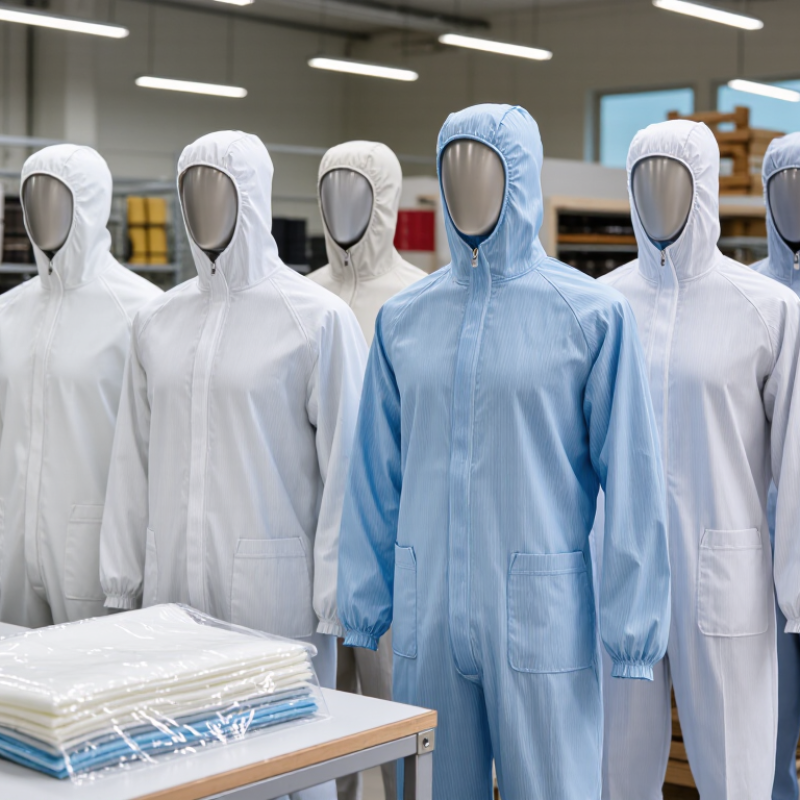
China’s leading disposable coverall manufacturers commonly work with 30–65 GSM nonwoven materials. This range supports different workplace needs, from light cleaning to controlled industrial handling. Spunbond polypropylene is widely used because it is lightweight, breathable, and economical. SMS fabric adds a meltblown layer for improved fluid resistance. Still, GSM alone does not prove protection quality.
Core product types include hooded coveralls, elastic-cuff styles, and designs with covered zippers. Some factories also produce antistatic, waterproof, or microporous versions. A 30–40 GSM coverall suits short tasks and warm environments. A 45–55 GSM model offers better balance for routine maintenance. Coveralls above 60 GSM feel stronger, but workers may experience more heat and restricted movement. That trade-off is easy to underestimate.
Tips: Check seam strength, zipper coverage, cuff elasticity, size grading, and packaging cleanliness. Request material samples before bulk purchasing. Ask for test reports that match the intended use, not generic documents. In my sourcing experience, a softer fabric often improves acceptance, yet softness can hide weak seams. I would also inspect hood fit and ankle closure in person. Measurements can vary between factories, and one sample is not enough evidence. Human comfort matters, but it should not replace documented performance checks.
China Top 10 Disposable Coverall Manufacturers - Disposable Coveralls in China: 30–65 GSM Materials and Core Product Types
| No. | Anonymous Manufacturer Profile | Primary Material | Typical GSM | Core Product Type | Common Applications | Typical Protection Position | Common Construction Features |
|---|---|---|---|---|---|---|---|
| 1 | Profile A – Basic hygiene-wear producer | PP spunbond nonwoven | 30–40 GSM | Standard hooded disposable coverall | Food processing, cleaning, visitor protection and general hygiene | Low-risk dry-particle and dirt protection; not liquid-proof | Elastic wrists and ankles, waist seam, front zipper, optional hood |
| 2 | Profile B – Lightweight production specialist | PP spunbond nonwoven | 40–45 GSM | Breathable disposable coverall with collar | Warehouse work, painting preparation, maintenance and dust control | Basic particulate barrier with limited splash resistance | Collar design, elastic cuffs, reinforced zipper area and low-lint fabric options |
| 3 | Profile C – SMS material converter | SMS nonwoven: spunbond, meltblown and spunbond layers | 45–55 GSM | SMS hooded coverall for improved particle filtration | Healthcare support areas, laboratories, electronics and clean handling | Improved dry-particle barrier and breathability; performance depends on test results | Three-layer structure, elastic face opening, storm-flap zipper and thumb-loop options |
| 4 | Profile D – High-filtration SMS producer | Enhanced SMS or SMMS nonwoven | 50–60 GSM | Full-coverage coverall with hood and shoe-cover integration | Pharmaceutical handling, laboratory work and controlled production areas | Higher particulate-control potential than single-layer PP; certification is product-specific | Elastic hood, wrists, ankles and waist; covered zipper; serged or bound seams |
| 5 | Profile E – Microporous laminate specialist | PP nonwoven with microporous PE film laminate | 45–55 GSM | Liquid-resistant disposable coverall | Industrial cleaning, chemical handling support and spray operations | Barrier against selected light liquid splashes when tested and certified | Film-faced outer surface, elastic openings, covered zipper and optional taped seams |
| 6 | Profile F – Chemical-splash garment producer | Breathable microporous film laminate | 55–65 GSM | Type 5/6-style hooded protective coverall | Chemical processing support, sanitation and contaminated-area work | Designed for dry-particle and limited liquid-spray protection where applicable | Bonded or taped seams, double storm flap, elastic hood and high-coverage closure system |
| 7 | Profile G – Antistatic garment producer | SMS or PP laminate with antistatic treatment | 45–60 GSM | Antistatic disposable coverall | Electronics assembly, powder handling and low-contamination production | Reduced electrostatic charge under specified test conditions; not electrical insulation | Conductive treatment or yarn system, hood, elastic closures and low-lint construction |
| 8 | Profile H – Medical-use coverall producer | SMS or spunbond nonwoven with optional film layer | 45–65 GSM | Medical-style disposable coverall with hood | Patient-care support, laboratory work and non-sterile medical environments | Protection level varies by bacterial, liquid and blood-penetration test results | Full-length zipper, elastic face and limb openings, low-lint options and individually packed units |
| 9 | Profile I – Cleanroom apparel producer | Low-lint SMS or laminated nonwoven | 40–55 GSM | Cleanroom-compatible disposable coverall | Semiconductor, pharmaceutical and precision assembly areas | Particle-shedding control; cleanroom suitability requires site-specific validation | Low-lint fabric, enclosed zipper, elastic hood and ankles, controlled packaging |
| 10 | Profile J – Customized OEM coverall producer | PP, SMS, SMMS or microporous laminate selected by specification | 30–65 GSM | Custom private-label pattern and packaging format | Industrial, healthcare, food, laboratory and general-purpose use | Protection claims must correspond to the selected material, seam design and verified standard | Custom sizing, zipper direction, seam type, hood design, packing quantity and carton marking |
Note: GSM means grams per square metre. Actual protection performance depends on the complete garment, including fabric, seams, closures and test certification. Common references include EN ISO 13688 for general protective-clothing requirements, EN 13034 for limited liquid chemicals and EN ISO 13982-1 for dry-particle protection.
Let's Work Together
The most innovative products come from the most innovative people - and for over 55 years our team has been propelled by curiosity and a steadfast dedication to inventing and creating the best foam formulations for our customers.