How to Choose Wall Cladding for Your Project?
Choosing Wall Cladding is not a purely visual decision. It affects thermal comfort, moisture control, maintenance, fire performance, and embodied carbon. A façade may look impressive in a showroom, yet fail when driven rain reaches its joints. That gap matters.
The 2024 Global Status Report for Buildings and Construction, published by UNEP and the Global Alliance for Buildings and Construction, states that buildings and construction consumed about 32% of global energy and produced approximately 34% of global carbon dioxide emissions in 2022. These figures make material selection more than a design preference. They connect cladding with energy demand, manufacturing impacts, transport, and replacement cycles. RICS Whole Life Carbon Assessment guidance also encourages project teams to evaluate carbon across a building’s complete life, rather than focusing only on initial cost.
A reliable choice begins with project evidence. Check local rainfall, freeze-thaw exposure, wind pressure, solar orientation, and the wall assembly behind the panels. Compare fire-test classifications, warranties, repair access, expected service life, and Environmental Product Declarations. Small details matter. A poorly sealed penetration can undermine an expensive façade.
Experience still has limits. A familiar material is not automatically suitable for every climate or structure. Cost estimates can also hide future cleaning, repainting, and replacement work. Review manufacturer data, independent test results, and the advice of qualified façade consultants. The best Wall Cladding solution balances appearance, performance, carbon, and practical maintenance. It should still make sense ten years after installation.
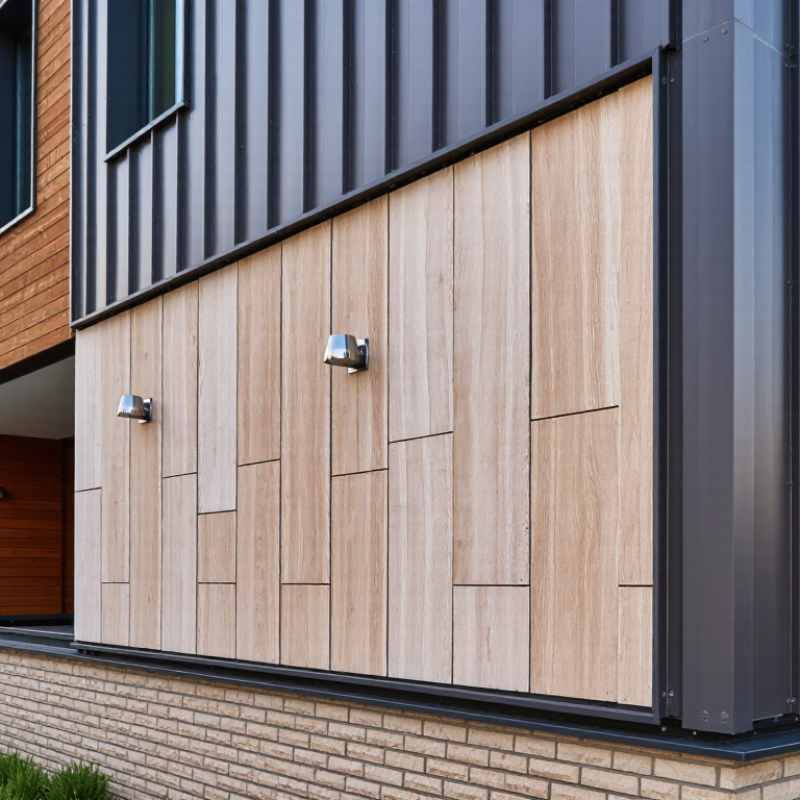
Define Project Requirements and Wall Cladding Goals
How to Choose Wall Cladding for Your Project?
Define Project Requirements and Wall Cladding Goals
Every cladding decision should begin with the building’s actual demands. Record the wall height, exposure, substrate, and expected service life. Note whether the project faces driving rain, coastal salt, strong sunlight, or repeated freezing. These details affect material stability, joint design, and fixing methods. They also influence the required fire performance.
Ask what the cladding must achieve. Is the priority thermal efficiency, acoustic control, impact resistance, or a distinctive appearance? A school may need durable surfaces and easy cleaning. A residential project may place greater value on warmth, texture, and low maintenance. Write these goals in measurable terms. “Modern” is vague. “Retain color with limited cleaning” is more useful.
Budgeting must include more than the panel price. Allow for support rails, insulation, flashings, access equipment, labor, repairs, and future cleaning. Check local building regulations and request verified technical data, including fire, moisture, wind-load, and durability results. An experienced installer can identify weak details before construction begins.
A practical lesson is that project briefs are rarely complete. One overlooked drainage path can damage an otherwise suitable system. Leave room to revise the specification after a site inspection. Sometimes the best choice is not the most attractive sample. It is the system that performs reliably at corners, openings, and joints.
Compare Wall Cladding Materials and Performance
Choosing wall cladding starts with the building’s exposure, not its appearance. A coastal apartment faces salt air, driving rain, and strong wind. A school corridor needs impact resistance and easy cleaning. The same material may perform well in one location and disappoint in another.
Fiber cement panels offer stable dimensions, good fire performance, and many textures. They need careful edge sealing and accurate joint detailing. Metal cladding is lightweight and fast to install, but dents and thermal movement require attention. Brick provides strong impact resistance and a familiar appearance, yet it adds weight and often needs a deeper support system. Timber creates warmth, although moisture management and regular maintenance cannot be ignored. I once saw beautiful timber panels darken around poorly ventilated joints. The material was not the only problem.
Compare test reports for fire, water penetration, wind load, and acoustic control. Check the complete wall build-up, including insulation, membranes, fixings, and cavity depth. A panel’s laboratory rating may change when installers use unsuitable fasteners or leave gaps around windows. Ask how repairs will work after ten years. Small scratches on a busy loading area can become expensive if replacement panels are unavailable. Cost also includes scaffolding, cleaning, repainting, and waste during installation. Measure twice. Details matter. Even experienced teams can overlook drainage behind a decorative screen. The best choice may be less striking, but more reliable under real weather and daily use.
Assess Climate, Building Conditions, and Installation Needs
How to Choose Wall Cladding for Your Project?
Climate should guide your wall cladding decision from the beginning. In wet regions, choose systems with reliable drainage and well-sealed joints. Coastal air can accelerate corrosion, especially around exposed fasteners. Cold climates require materials that tolerate repeated freezing and thawing. Strong sunlight may cause fading, surface movement, or cracking. Check local wind, rainfall, humidity, and temperature records before selecting a finish. Small climate details matter.
Building conditions are equally important. Inspect the substrate for moisture, uneven areas, cracks, and weak fixing points. A moisture meter can reveal problems hidden behind clean-looking walls. Cladding cannot repair a leaking envelope. It may only conceal it. I once saw a well-installed system fail because the existing wall stayed damp. That mistake was avoidable, but site assumptions made it expensive. Consider insulation depth, ventilation gaps, fire performance, and movement joints. Confirm the entire wall assembly, not just the outer panel.
Tips: Ask for installation drawings early. Match fixings to the substrate. Keep drainage paths open. Allow for thermal movement. Use a sample on the actual elevation. Inspect corners and penetrations closely. If the installer cannot explain moisture management clearly, pause the decision. Installation conditions may change after delivery, so leave room for practical adjustments. Perfect plans sometimes meet imperfect walls.
Evaluate Costs, Maintenance, and Long-Term Value
How to Choose Wall Cladding for Your Project?
Cladding cost begins with purchase and installation, but it does not end there. Request a life-cycle cost model, not only a supplier quotation. Include fasteners, access equipment, cleaning, inspections, repairs, replacement, and disposal. RICS’s Life Cycle Costing guidance recommends comparing these future costs using transparent assumptions and discount rates. Small assumptions can change the result.
Maintenance deserves a site-specific review. Ask how dust, salt, rain, ultraviolet exposure, and temperature movement affect the selected material. During a project review, inspect joints, corners, drainage paths, and exposed fixings. A beautiful panel can still fail through poor detailing. That is the uncomfortable part. The material may not be the real problem.
Long-term value also includes energy, resilience, and carbon. UNEP’s 2023 Global Status Report for Buildings and Construction states that buildings and construction produced 37% of global energy-related emissions in 2022. Cladding alone cannot solve this, but durable detailing can reduce replacement waste and operational risks. Compare expected service life with maintenance intervals, backed by tested performance data. Do not treat optimistic service-life claims as guarantees. Local weather, workmanship, and cleaning practices can weaken them. A cheaper system may win on day one and lose after repeated repairs. A higher-priced option may also disappoint if installation quality is ignored.
Select the Best Cladding System for Your Project
How to Choose Wall Cladding for Your Project?
Select the Best Cladding System for Your Project
Selecting the best cladding system starts with the building, not the sample board. Check the substrate, local climate, wind pressure, moisture paths, and fire requirements. A drained and ventilated cavity can help manage rain behind the outer layer. It also gives installers a clearer path for correcting uneven walls. The 2023 Global Status Report for Buildings and Construction reports that buildings consume about 32% of global energy. They also produce roughly 34% of global carbon dioxide emissions. This makes thermal performance more than a design preference. It affects operating costs and long-term carbon impact.
Thermal resistance should match the project’s climate and mechanical strategy. The International Energy Agency’s The Future of Cooling report projected that cooling electricity demand could more than triple by 2050. A well-designed envelope may reduce heat gain, but results depend on joints, insulation continuity, and workmanship. Some choices look perfect on drawings. They may fail around windows, corners, or service penetrations. Review tested fire performance, water resistance, wind loading, acoustic needs, and replacement access. Do not judge a system from its face material alone.
Tips: Request full-scale mock-ups before approval. Inspect corners, fasteners, flashings, and cavity openings. Compare lifecycle maintenance, not only purchase price. Ask how damaged panels will be replaced. Allow for mistakes. A slightly simpler system may perform better when local installers can build it accurately. Record assumptions in the specification, then verify them during site inspections.
How to Choose Wall Cladding for Your Project? Compare representative installed weights before selecting a cladding system. Lightweight systems can reduce structural loads and simplify installation, while heavier systems may provide greater mass, durability, or traditional appearance.
Values are typical mid-range installed weights for common non-branded cladding systems. Actual weights vary with thickness, framing, insulation, substructure, and fixing method; confirm final values with project-specific technical data.