How to Choose Private Label Makeup Manufacturers?
Choosing Private Label Makeup Manufacturers is not just a search for attractive packaging or a low quote. The right partner should be able to explain how a formula is developed, tested, produced, and packed. A smooth lipstick sample is useful, but it does not tell you how consistently the next production run will perform. Details matter.
This guide focuses on practical checks buyers can make before committing. Ask for product specifications, ingredient information, quality-control procedures, and relevant test documentation. Request samples in the intended packaging, then assess texture, shade, scent, and application under ordinary use. Ask twice if an answer is unclear. A manufacturer’s willingness to discuss limitations can be as telling as its sales presentation.
Compare minimum order quantities, lead times, customization options, and communication practices alongside price. Confirm who sources components and how changes to a formula or package are approved. Make sure product descriptions and claims are reviewed appropriately for the markets where you plan to sell; requirements can vary, so qualified guidance may be needed. No factory can remove every business risk, and early estimates may change. That is worth reflecting on before placing an order. By weighing evidence, asking specific questions, and documenting decisions, you can choose a manufacturing partner with clearer expectations and a stronger foundation for your makeup line.
Define Your Product Range and Manufacturing Requirements
Before contacting private label makeup manufacturers, define the products you actually plan to sell. A focused range might include a cream blush, a sheer lipstick, and a compact powder. For each item, note the finish, texture, shade count, and intended packaging. Be specific. “Natural-looking” is less useful than “soft matte, medium coverage, in six neutral shades.” A clear brief helps manufacturers assess whether their equipment and formulation capabilities fit your needs.
Set practical manufacturing requirements, too. Record your target order quantity, preferred packaging materials, expected production timeline, and budget range. Ask about sample development, minimum order quantities, stability testing, and batch quality checks. Request details about ingredient documentation and how changes to a formula are reviewed. These questions can reveal gaps before you commit. Small details matter, like whether a compact can withstand repeated opening or a lipstick bullet stays secure in its tube.
It is tempting to specify every detail immediately. Some requirements may change after you test samples, and that is normal. Keep essential standards firm, but leave room for informed adjustments. A first brief can still miss something. Share your priorities clearly, then compare manufacturers against the same requirements rather than relying on polished presentations alone.
How to Choose Private Label Makeup Manufacturers
Define Your Product Range and Manufacturing Requirements
Example planning scores (1 = lower priority, 5 = higher priority) help compare requirements before contacting manufacturers. Adjust them to match your product range, target market, and launch plan; these scores are not survey results.
Assess Manufacturer Expertise, Certifications, and Regulatory Compliance
Choosing a private label makeup manufacturer requires more than reviewing a product catalogue. Ask how long the team has worked with your product type and whether it can explain formulation choices clearly. For a lipstick, discuss pigment dispersion, heat stability, and how the formula behaves after repeated use. Request sample batches and ask what changes were made between versions. Specific answers matter.
Check certifications carefully. Confirm the certificate is current, covers the actual production site, and comes from a credible issuing body. A certificate alone is not proof of consistent quality. Ask to see quality procedures, batch records, and testing plans for stability and microbiological safety where relevant. Watch how staff handle questions. Vague answers are a warning.
Regulatory compliance depends on where you plan to sell and how you describe the product. Ask who reviews ingredient lists, labels, safety documents, and marketing claims for each target market. Request examples of controlled records, such as approved artwork and traceable batch documentation, with confidential details removed. I would not rely on a confident sales call alone; written responsibilities and independent verification are more useful. Sometimes the paperwork looks neat, but the process needs closer inspection.
How to Choose Private Label Makeup Manufacturers? - Assess Manufacturer Expertise, Certifications, and Regulatory Compliance
| Assessment Dimension | What to Verify | Why It Matters | Practical Evaluation |
|---|---|---|---|
| Makeup Product Expertise | Relevant experience with the specific product format, such as pressed powder, mascara, lipstick, liquid foundation, or cream blush. | Different formats require different formulation, filling, packaging, and quality-control capabilities. | Ask for anonymized examples of comparable products, available formulation options, minimum order quantities, and typical development timelines. |
| Formulation and Ingredient Controls | Documented ingredient specifications, supplier qualification, batch records, and a process for reviewing restricted or prohibited ingredients in target markets. | Ingredient requirements vary by product and jurisdiction; controlled documentation supports traceability and consistent production. | Review a sample specification and ask how ingredient changes are assessed, approved, and communicated before production. |
| Quality Management and GMP | Written procedures for manufacturing, sanitation, personnel training, equipment maintenance, batch release, deviations, and corrective actions. | Good manufacturing practices help reduce contamination risks and production inconsistencies. | Request a current audit summary or relevant certification scope. ISO 22716 addresses cosmetics GMP; verify the certifying body, site, scope, and validity. Certification alone does not guarantee product compliance. |
| Facility and Process Controls | Suitable production areas, cleaning controls, calibrated equipment, controlled storage, and segregation practices where needed. | Facility controls help protect product quality and prevent mix-ups or contamination. | Ask whether the proposed manufacturing site is the site named in quality documents and whether a remote or on-site audit is available. |
| Product Safety and Testing | Risk-based testing appropriate to the formula and use, which may include stability, packaging compatibility, microbiological quality, and preservative efficacy testing for applicable water-containing products. | Testing helps evaluate whether a product remains suitable under expected storage and use conditions. | Request test protocols, acceptance criteria, reports for the proposed formula and packaging, and an explanation of any test exclusions. Testing needs depend on product type and risk. |
| United States Regulatory Readiness | Ability to support applicable requirements under the Federal Food, Drug, and Cosmetic Act and the Modernization of Cosmetics Regulation Act (MoCRA), including facility registration and product listing where required. | MoCRA introduced additional obligations for responsible persons and certain manufacturing facilities. FDA cosmetic facility registration and product listing are not FDA approval or endorsement. | Clarify who will handle each applicable filing and keep evidence of submitted information. Confirm whether an exemption applies rather than assuming all businesses have identical obligations. |
| European Union Regulatory Readiness | Support for Regulation (EC) No 1223/2009, including an EU-based Responsible Person, a Cosmetic Product Safety Report (CPSR), a Product Information File (PIF), and CPNP notification before the product is placed on the EU market. | These are key requirements for cosmetics marketed in the EU; the Responsible Person must ensure the product meets applicable obligations. | Identify the proposed Responsible Person and confirm who prepares, holds, and updates the safety documentation. A manufacturer’s general compliance claim is not a substitute for product-specific records. |
| Labeling and Claims Support | Ability to provide accurate product information for applicable ingredient declarations, warnings, batch identification, responsible-party details, and market-specific labeling. | Labeling rules differ by market, and product claims must be appropriate and substantiated. Claims that imply treatment or prevention of disease may change a product’s regulatory status in some jurisdictions. | Request a label review workflow and evidence supporting proposed claims. Have final artwork reviewed for each intended market before printing. |
| Traceability and Recall Readiness | Records linking raw-material lots to finished-product batches, along with complaint handling, investigation, and recall procedures. | Traceability supports investigations and timely action if a quality or safety issue arises. | Ask how quickly the manufacturer can identify affected batches and request a description of its mock-recall or traceability exercise process. |
| Certification and Document Verification | Current, relevant certificates and audit documents, with a clearly stated scope, manufacturing site, issuing organization, and validity period. | Certificates may cover only particular sites or activities and do not replace legal responsibilities or product-specific assessments. | Verify documents with the issuing organization where possible; check that the certificate applies to the actual product category and production location. |
| Supplier Communication and Change Control | Written procedures for approving formula, raw-material supplier, manufacturing-site, packaging, and process changes. | Unreviewed changes can affect product performance, safety assessments, test results, or labeling accuracy. | Agree on advance written notice, approval responsibilities, retained samples, and updated testing or regulatory reviews when changes occur. |
Compare Formulation Options, Customization, Minimum Orders, and Costs
Choosing a private label makeup manufacturer starts with the formula. Stock formulas can shorten development time and suit straightforward products, such as a clear gloss or everyday foundation. Semi-custom options may allow changes to shade, finish, scent, or selected ingredients. Fully custom formulas offer more control, but often require extra testing, longer timelines, and higher development costs. Ask what “custom” means in the manufacturer’s process. The word can cover very different levels of work.
Customization affects more than the product itself. You may be able to choose packaging, applicators, finishes, and label placement. Request physical samples in the intended packaging, then check color under daylight and indoor lighting. A shade that looks right on a screen may appear warmer in a compact. Small detail. Confirm how many sample revisions are included and whether changes affect the schedule. I would not approve a large run from one rushed sample; real wear can reveal issues that a quick swatch misses.
Minimum order quantities vary by formula, shade, and packaging. A low MOQ can help test demand, while a larger order may reduce unit cost but tie up cash and storage space. Compare the full quote, not just the price per unit. Include sample fees, setup charges, packaging, freight, and any testing costs. Ask for these figures in writing, along with production lead times and payment terms. One cost is easy to overlook: extra inventory if a shade sells slowly.
Test Product Samples and Review Quality Control Processes
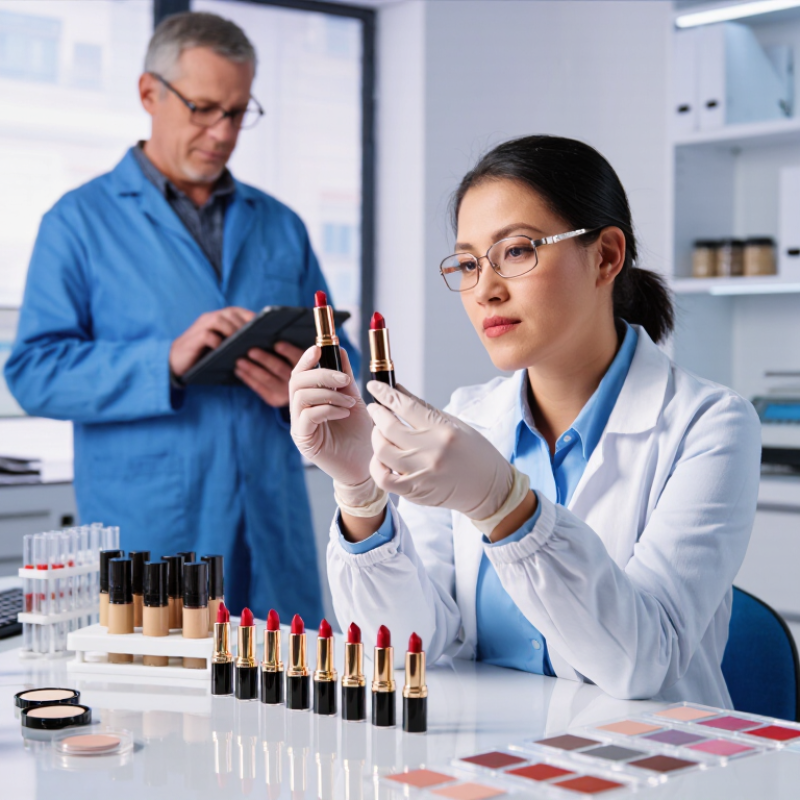
A product sample is more than a shade match. Test several units, not just the best-looking one. Check color in daylight and indoor lighting, then note texture, scent, coverage, and how evenly the formula applies. For lipstick or cream products, watch for sweating, separation, or changes in feel after repeated use. Look closely. Small differences between units may signal inconsistent production.
Ask the manufacturer how samples are selected and whether they represent a regular production batch. Test the packaging too: close and reopen caps, inspect seals, and check for leaks after gentle handling. Keep notes with dates, photos, and the sample’s batch details. A sample can still fool you; it may have been prepared with extra attention. Ask for another set before making a decision.
Review the quality control process in practical terms. Request details on incoming ingredient checks, in-process inspections, finished-product testing, and how defects are recorded and addressed. Ask how batches are identified and whether inspection records can be shared. Clear answers matter more than polished claims. If a process sounds vague, ask for a concrete example, such as how the team handles a fill-weight variation. Not every small variation is a failure, but the manufacturer should explain its limits and corrective steps.
Evaluate Communication, Contracts, Lead Times, and Growth Capacity
A manufacturer’s communication habits become visible before production begins. Send a short list of practical questions about formula options, packaging compatibility, and sample revisions. Notice whether answers are specific or simply reassuring. Ask who will manage daily updates and how delays will be reported. That matters. A clear contact and written recap can prevent small changes from being missed.
Read the contract alongside the production schedule. Confirm what each sample includes, how revisions are handled, and which party approves final packaging and specifications. Check payment milestones, order minimums, quality expectations, and procedures for resolving discrepancies. Have unclear terms reviewed by a qualified professional. Lead times should separate sampling, component sourcing, production, and shipping; one broad estimate can hide weeks of waiting. Ask what happens if a cap or carton arrives late. Build in a buffer. Real schedules can slip.
Growth capacity needs evidence, not promises. Ask how the factory would handle a larger repeat order, including equipment availability, staffing, and inspection at each batch stage. Request realistic capacity ranges and references where available, while protecting confidential information. A small pilot run can reveal how updates, documentation, and quality checks work under pressure. Scaling too quickly may strain both sides. I would still revisit the plan after the first order; forecasts are imperfect, and actual demand may surprise you.
Article Source:
Let's Work Together
The most innovative products come from the most innovative people - and for over 55 years our team has been propelled by curiosity and a steadfast dedication to inventing and creating the best foam formulations for our customers.