China Top Kids Puzzle Toys Manufacturers for Global Buyers
China has become a major sourcing base for Kids Puzzle Toys, serving retailers, educators, and distributors worldwide. Its manufacturing network covers wooden puzzles, cardboard jigsaws, magnetic designs, and early-learning activity sets. Yet factory scale alone does not guarantee a dependable product.
Experienced buyers examine more than catalog photographs. They review material quality, cutting precision, printing durability, packaging details, and production consistency. A well-made puzzle should feel smooth in a child’s hands. Pieces should connect firmly without excessive force. Images must remain clear after repeated use. Small details matter.
Dr. Stuart Brown, a leading play researcher and founder of the National Institute for Play, said, “The opposite of play is not work—the opposite of play is depression.” His observation explains why thoughtful puzzle design deserves serious attention. Kids Puzzle Toys should encourage concentration, discovery, and calm problem-solving, rather than simply fill a shelf.
Reliable Chinese manufacturers usually provide prototype development, quality inspections, packaging customization, and export experience. Buyers should still request samples and verify testing documentation independently. Claims can sound impressive. Evidence matters more.
Age grading, piece size, paint quality, and edge finishing require careful review. A supplier may offer a low price, but hidden defects can damage customer trust. That lesson is easy to overlook.
This guide introduces leading China-based manufacturers for global buyers. It considers product craftsmanship, communication, customization, production capacity, and responsible quality practices. No supplier is perfect. Even strong factories may need clearer specifications or closer inspection. Careful comparison remains the safest purchasing strategy.
China’s Role in the Global Kids Puzzle Toy Manufacturing Industry
China’s role in the global kids puzzle toy industry is substantial, supported by mature supply chains and flexible production capacity. UN Comtrade data for HS 9503, which includes toys and games, consistently places China among the world’s leading exporters. However, this category is broader than puzzles, so the figures should not be treated as puzzle-specific evidence.
Market demand remains resilient but uneven. Grand View Research estimated the global toys market at about USD 108.7 billion in 2023, with continued growth projected through 2030. Circana reported a decline in global toy sales during 2023, yet games and puzzles showed stronger resistance than several traditional categories. This shift is visible in factories producing floor puzzles, wooden logic boards, and compact travel sets. Production lines can change formats quickly, sometimes within a few days.
Quality still separates reliable manufacturers from ordinary suppliers. Experienced factories normally control die-cut accuracy, edge smoothness, color consistency, and small-part safety. They also prepare testing for standards such as EN 71, ASTM F963, and ISO 8124, depending on the destination market. Yet compliance documents alone are not enough. Sampling, batch records, and real communication matter more than polished brochures.
Some weaknesses remain. Small suppliers may underestimate packaging durability or age grading. Buyers should inspect samples under practical conditions, not only in showrooms. A puzzle that fits perfectly on a factory table may fail after rough shipping.
China’s Role in the Global Kids Puzzle Toy Manufacturing Industry
China remains a major global manufacturing and export hub for children’s toys, including jigsaw and educational puzzle products. The chart shows China’s annual export value for HS 9503, a broad international trade category covering toys, games, puzzles and related products.
Source: UN Comtrade international trade statistics, HS 9503; values rounded to the nearest US$0.1 billion.
Key Types of Kids Puzzle Toys Made by Chinese Manufacturers
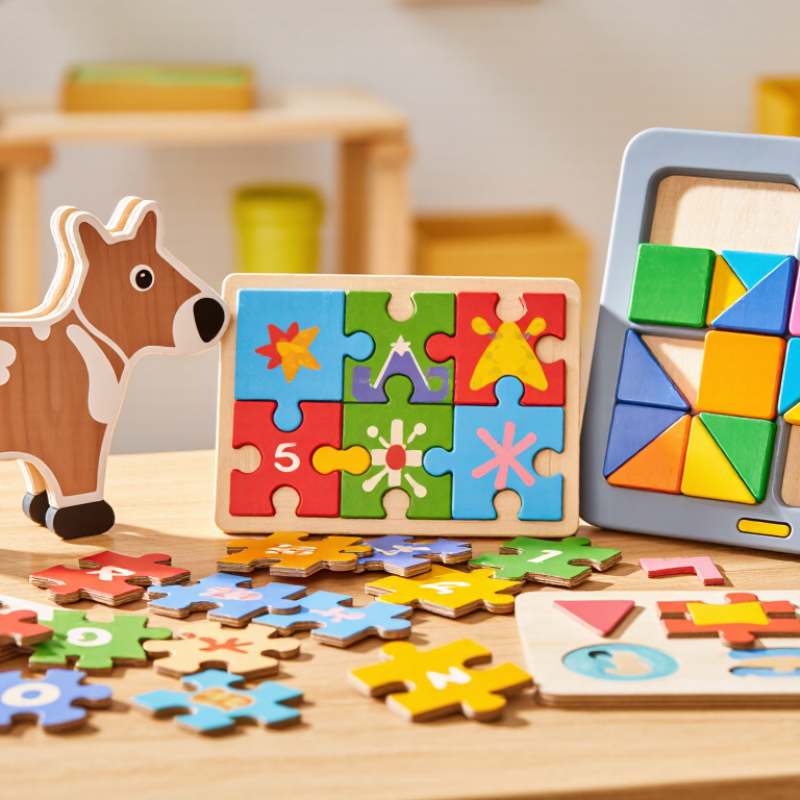
Chinese manufacturers produce several practical types of kids puzzle toys for global buyers. Wooden peg puzzles use thick pieces and simple animal shapes. They suit toddlers developing grip and matching skills. Jigsaw puzzles range from 12-piece sets to complex 1,000-piece designs. Magnetic puzzles add movable scenes, while floor puzzles create larger cooperative play.
Three-dimensional puzzles use layered wood, foam, or paper components. They introduce structure, balance, and spatial thinking. Logic puzzles and maze boards support older children who need longer challenges.
The global educational toys market was valued at about USD 34.2 billion in 2023, according to Grand View Research. This growth reflects demand for learning through play, but market size does not guarantee product quality. Careful testing still matters.
Tips: Ask factories for age grading, material reports, edge checks, and sample testing. Confirm whether paints meet the destination market’s safety requirements. Check magnet strength and small-part risks. A good sample should feel smooth, stable, and easy to clean. Buyers should also review packaging drop tests and instruction clarity. Small details matter. I have seen attractive puzzles fail because pieces warped during humid storage. Choosing the cheapest supplier can create higher inspection and return costs. Suppliers with documented quality systems are usually more reliable, though documentation alone is never enough.
How to Evaluate China-Based Puzzle Toy Suppliers
China Top Kids Puzzle Toys Manufacturers for Global Buyers
How to Evaluate China-Based Puzzle Toy Suppliers
A reliable supplier evaluation starts beyond a polished online catalog. Ask for a factory profile, production photos, and current business licenses. Check whether the supplier produces puzzles regularly or simply trades unrelated products. Direct factory visits help, but a live video audit can reveal storage conditions, assembly lines, and quality checkpoints.
Request samples from the same production line used for bulk orders. Examine cutting accuracy, surface smoothness, color consistency, and packaging strength. Small puzzle pieces should fit correctly without sharp edges or loose printing. Ask for material specifications and independent safety test reports for your target market. Documents must match the actual product, not an older sample. This detail is often missed.
Communication matters. Send a simple specification sheet covering dimensions, piece count, artwork, carton size, labeling, and delivery terms. Measure how clearly the supplier answers technical questions. Vague replies may become costly delays. Review their quality-control process, including incoming material checks, in-process inspections, and final sampling. Confirm production capacity during busy seasons. A low quotation can hide weak inspection or unstable lead times. I have seen attractive samples fail during carton compression tests. That mistake changed the evaluation method: test packaging, not only the toy. Keep written records of revisions, approvals, and corrective actions. Reliability is shown through repeatable details.
Production Standards, Safety Testing, and Quality Control
China Top Kids Puzzle Toys Manufacturers for Global Buyers
Reliable puzzle toy production begins with controlled materials and clear specifications. Manufacturers should inspect wood, cardboard, coatings, magnets, and plastic parts before assembly. Moisture levels matter because warped boards can create sharp edges. Production teams should follow applicable requirements, such as GB 6675, EN 71, ASTM F963, or ISO 8124. The exact standard depends on the destination market.
Safety testing should reflect real use, not only paperwork. Inspectors commonly check small parts, edge sharpness, coating adhesion, odor, and mechanical strength. Pull tests can reveal loose knobs. Drop tests may expose hidden cracks. Chemical testing should screen restricted substances in paints, inks, plastics, and adhesives. Every batch needs traceable records, including material lots, test results, and corrective actions. A perfect sample does not guarantee a perfect shipment.
Tips: Ask for recent third-party reports and factory inspection records. Request samples from normal production, not only hand-finished samples. Check puzzle fit, print quality, and packaging damage yourself. Keep a signed approval sample. It prevents arguments later. Also, allow reasonable tolerance for color and cutting, but never accept unsafe edges or loose pieces. In practice, quality control can miss small defects. That is why layered inspections remain valuable. A final random check before shipment may catch the problem nobody noticed earlier.