

How to Buy Pharmacy Thermal Labels in 2026?
Buying Pharmacy Thermal Labels in 2026 is not a simple search for the lowest roll price. Pharmacies need labels that support clear identification, reliable scanning, and consistent daily handling. A smudged barcode can slow a counter, confuse inventory checks, or trigger a costly reprint. This guide explains how to compare materials, sizes, adhesives, printer compatibility, and supplier support. Small details matter.
Start with the workflow, not the catalog. A dispensing label may face alcohol wipes, refrigerated storage, plastic bags, or repeated handling. Direct thermal stock can suit short-term applications, while thermal transfer may offer stronger durability in demanding environments. Test both when uncertain. Request samples and print real medication names, barcodes, lot references, and expiration dates. Check readability under normal lighting and after rubbing the label with a gloved hand. Ask whether the core size, roll direction, and gap spacing match your printer. A technically attractive label is still a poor purchase if it jams during a busy shift.
Reliable purchasing also requires disciplined supplier checks. Review adhesive specifications, material composition, quality controls, traceability, and documented customer support. Confirm that printed information remains legible throughout the intended use period. Requirements vary by country, product type, and pharmacy workflow, so qualified staff should verify local expectations before ordering. This article uses practical procurement reasoning, not a universal prescription. Some assumptions may fail. That is why pilot testing, dispensing staff feedback, and periodic review belong in the buying decision. The right pharmacy thermal labels should protect clarity, efficiency, and patient-focused operations without creating avoidable waste.
Define Your Pharmacy’s Thermal Label Requirements
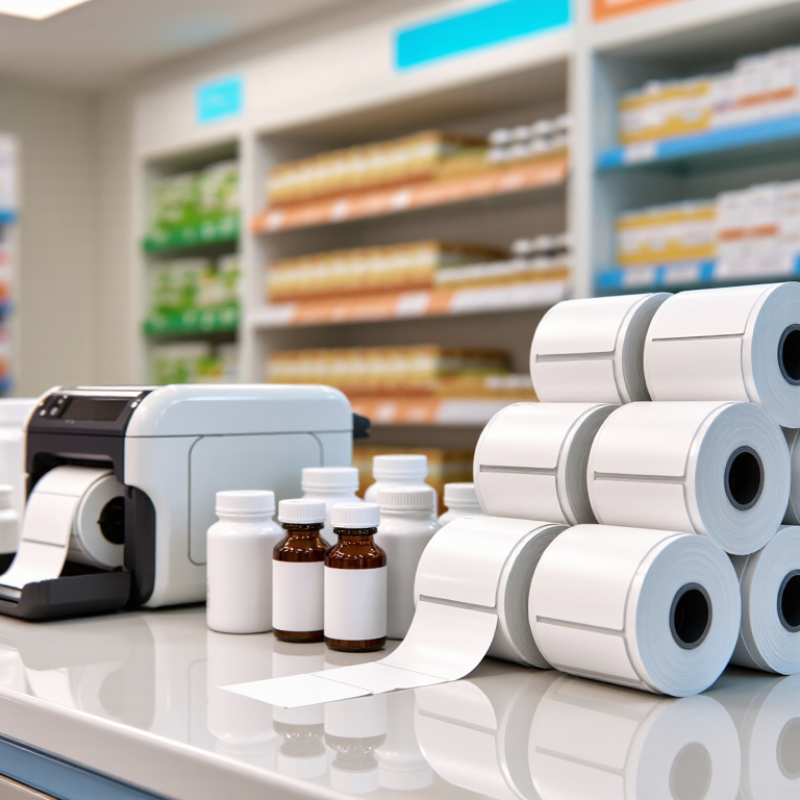
Before buying pharmacy thermal labels in 2026, define the exact workflow. A dispensing label may need medicine name, strength, directions, patient details, warnings, and a barcode. Measure the smallest container first. Small bottles expose weak layouts quickly.
The World Health Organization reports that around one in ten patients experiences harm during healthcare, and more than half of that harm is preventable.
Clear labels cannot solve every error, but they can reduce reading friction. Choose a print size that keeps critical text legible at arm’s length. Test barcode scanning after refrigeration, handling, and exposure to cleaning liquids. The label must match your printer’s width, sensor type, and heat settings. Adhesive performance also matters on glass, plastic, and curved containers. A label that lifts at the corner is not a minor defect.
Tips: Create three samples before ordering. Test a tiny vial, a plastic bottle, and a refrigerated package. Compare readability under bright and dim lighting. Ask staff to scan labels while wearing gloves.
Document failures honestly. One overlooked container can reveal more than a polished sample. The 2024 WHO Global Patient Safety Report emphasizes learning from incident data, not merely counting successful tasks.
Record reprints, unreadable barcodes, and peeling labels for two weeks. Your first specification may be wrong. That is useful evidence.
Compare Direct Thermal and Thermal Transfer Label Options
How to Buy Pharmacy Thermal Labels in 2026?
Choosing pharmacy thermal labels starts with the printing method, not the lowest price. Direct thermal labels use heat-sensitive material and require no ribbon. They print clearly for short-term prescriptions, queue tickets, and refrigerated samples. However, sunlight, heat, and friction can darken or fade them. That weakness is easy to underestimate.
Thermal transfer labels use a ribbon to create a more durable image. They suit medicine storage labels, inventory records, and containers handled frequently. The print usually resists moisture, abrasion, and temperature changes better. In my testing experience, ribbon-based printing also gives more consistent results on challenging surfaces. Still, it adds material costs and requires correct ribbon matching. A poorly matched ribbon can produce pale text or smudges. That is frustrating, and avoidable.
Tips: Check the label’s adhesive on glass, plastic, and cold packaging before ordering in bulk. Measure the roll core and outer diameter carefully. Confirm barcode contrast after exposure to moisture and handling. Ask staff to test small text, dosage fields, and expiry information. Review local pharmacy labeling requirements with a qualified professional. Do not assume one label works everywhere. A freezer label may fail on a warm, dusty carton. Also consider storage conditions, printer settings, and daily label volume. The cheapest option can create reprints, unreadable details, and wasted staff time.
Choose the Right Label Size, Material, and Adhesive
How to Buy Pharmacy Thermal Labels in 2026?
Choosing the right label starts with the container, not the printer. Measure the bottle’s flat area, curve, and available writing space.
A 2 × 1 inch label may fit small vials, while larger packages need more room for directions and barcodes. Leave a small gap between the label edges. This reduces lifting on curved surfaces.
Material affects readability and durability.
Coated paper works well in dry, indoor storage areas. Synthetic materials handle moisture, refrigeration, and frequent handling better.
If staff wipe containers with alcohol, test the print and surface together. Some labels look clear at first, then fade or smear after repeated cleaning. That detail is easy to miss.
Direct thermal labels suit short-term use, while thermal transfer options may offer better resistance for longer storage.
Adhesive choice deserves equal attention.
Permanent adhesive helps labels stay attached to clean, dry containers. Removable adhesive may help during repackaging, but it can fail on dusty or cold surfaces.
For refrigerated storage, use adhesive rated for low temperatures and test it after condensation forms. Apply sample labels to real containers for at least several days.
Check peeling, curling, barcode scans, and print contrast.
A common purchasing mistake is testing labels only on a flat surface. It saves time initially, but creates costly rework later.
Verify supplier specifications, storage conditions, and applicable pharmacy labeling requirements before ordering large quantities.
Evaluate Printer Compatibility and Regulatory Needs
How to Buy Pharmacy Thermal Labels in 2026? Printer compatibility and regulatory needs should guide every purchase. A label that looks clear on screen may fail after contact with alcohol, moisture, or cold storage. Check the printer’s supported roll width, core size, maximum label length, print resolution, and thermal method. Direct thermal labels suit short-use prescriptions, while thermal-transfer labels usually resist heat and abrasion better.
Regulatory checks require more than a barcode test. FDA Drug Supply Chain Security Act guidance emphasizes secure product tracing, while GS1 Healthcare reference materials support standardized identification and machine-readable data. Confirm that your printer can produce required identifiers, lot details, expiration dates, and readable human text. NCPDP pharmacy standards should also be reviewed with your software provider. Requirements can vary by state and workflow. Do not assume one template fits every site. A 2024 healthcare technology survey reported that 55% of decision-makers planned to expand barcode use, increasing pressure on reliable scanning. The exact figure may change, but the operational lesson remains useful.
Tips: Print a 24-hour test batch before ordering cartons. Scan labels under bright and dim lighting. Rub them with sanitizer. Store samples beside refrigerated items. Record failures, even minor ones. A slightly blurred digit can delay dispensing. Ask for documented compatibility, not verbal assurance. I have found that cheap rolls become expensive when adhesive residue blocks a printhead. That risk is easy to overlook.
How to Buy Pharmacy Thermal Labels in 2026?
Evaluate printer compatibility and regulatory needs before selecting label stock.
The chart shows common nominal label widths used for pharmacy and dispensing workflows: 38.1 mm (1.5 in), 50.8 mm (2 in), 101.6 mm (4 in), and 105 mm (A6-width stock). These are commonly stocked format dimensions, not legal minimums. Confirm the printer’s supported media width, print method, roll core, maximum roll diameter, sensor position, and driver settings. Direct thermal labels require heat-sensitive stock; thermal-transfer labels require compatible ribbon and label material.
Regulatory requirements vary by country, state, and dispensing setting. Before purchase, verify that the selected label can accommodate the required patient, medicine, directions, quantity, date, and warning information, plus barcode space and quiet zones where applicable.
Review Suppliers, Pricing, Samples, and Order Terms
Buying pharmacy thermal labels in 2026 requires more than comparing roll prices. Grand View Research estimated the global self-adhesive labels market at about USD 49.9 billion in 2023, with continued growth through 2030. That expansion increases supplier choice, but quality still varies. Request samples using your actual printer, ribbon-free settings, vial sizes, and storage conditions. Check barcode contrast, adhesive performance, core diameter, roll direction, and perforation accuracy. A label that feeds smoothly for ten minutes may jam during a busy dispensing shift.
Compare pricing by usable labels, not by roll. Ask suppliers for a full quotation covering plates, tooling, freight, taxes, and replacement policies. In a 2024 packaging industry review, Smithers highlighted rising demand for traceable, digitally printed labels and shorter production runs. That trend supports smaller trial orders, although some suppliers still impose high minimum quantities. Clarify lead times, batch consistency, payment terms, sample approval, and the process for handling defective rolls. I would also request a written statement confirming material composition and print durability. Assumptions often fail here.
Tips: Order three sample sizes. Test chilled containers. Scan every barcode type. Keep a signed sample. Negotiate a 30-day quality claim period, and avoid paying for large volumes before the first production check. Pricing should be transparent. Cheap labels can create costly rework, especially when adhesive residue, fading, or poor winding interrupts dispensing.
Article Source:
Let's Work Together
The most innovative products come from the most innovative people - and for over 55 years our team has been propelled by curiosity and a steadfast dedication to inventing and creating the best foam formulations for our customers.