10 Best LED Ceiling Lights for Global Buyers
Choosing the right Led Ceiling Light is no longer only a matter of brightness or appearance. Global buyers also examine energy use, color quality, installation safety, warranty terms, and long-term reliability. A ceiling fixture may look excellent in a showroom, yet create glare across a dining table or show uneven light on a white ceiling.
Energy performance makes this decision more important. The International Energy Agency reports that lighting accounts for roughly 15% of global electricity consumption. The U.S. Department of Energy states that LED products can use at least 75% less energy and last up to 25 times longer than incandescent lighting. These figures support LED adoption, but product quality still varies widely. A low-cost unit may have weak heat management, limited dimming compatibility, or a driver that fails before the advertised lifespan.
Small details matter.
This guide evaluates ten ceiling lights for international purchasing conditions. Our assessment considers lumens, watts, color temperature, color rendering index, beam distribution, protection ratings, driver quality, certifications, and replacement support. The International Electrotechnical Commission’s lighting standards also provide useful reference points for safety and performance comparisons. However, no ranking fits every home, office, hotel, or retail space. Room height, voltage, climate, and local installation rules can change the result.
We have included practical observations, not just manufacturer claims. Some specifications remain difficult to verify across markets. That limitation deserves honesty. The best Led Ceiling Light balances comfortable illumination, dependable construction, efficient operation, and realistic after-sales service.
How LED Ceiling Lights Work and Why They Suit Global Buyers
LED ceiling lights create illumination through a semiconductor called a light-emitting diode. Electrical current passes through the diode and produces visible light with little wasted heat. A driver controls this current before it reaches the LED chips. This small component affects brightness, flicker, lifespan, and safety. In practical installations, reliable drivers matter as much as the LEDs.
For global buyers, ceiling lights must handle different voltages, room sizes, and installation habits. Check the rated input range before ordering. Some models support broad voltage ranges, while others require a specific supply. Color temperature also changes the room’s character. Warm white suits bedrooms, while neutral white often works better in kitchens and offices. Lumens describe brightness more accurately than wattage. A 24-watt fixture may not match another 24-watt fixture.
Look for clear electrical markings, tested insulation, and documented safety compliance for the destination market. Moisture-rated housings are useful in bathrooms, but ratings must match the actual installation area. Measure the ceiling box and mounting holes carefully. A beautiful light can still become a poor purchase if the bracket does not fit. Dimming is another concern. Compatibility depends on the driver and the dimmer, not only the lamp.
LEDs usually consume less electricity and need fewer replacements. However, heat remains a real problem. Poor ventilation can shorten service life, despite impressive packaging claims. I have seen buyers focus on brightness and overlook glare. That choice can make a room uncomfortable. Good selection requires checking light distribution, warranty terms, spare parts, and local installation rules.
Key Features for Comparing LED Ceiling Lights
10 Best LED Ceiling Lights for Global Buyers
Comparing LED ceiling lights starts with useful light, not the highest wattage. The U.S. Department of Energy reports that LED lighting can use at least 75% less energy than incandescent lighting and last up to 25 times longer. Check lumens, watts, and efficacy together. A practical target is 100 lumens per watt or higher for general rooms. However, advertised figures may reflect laboratory conditions. Real performance can drop with heat, poor drivers, or enclosed fixtures.
Color quality matters near faces, food, and artwork. Choose a color temperature around 2700K–3000K for bedrooms and 3500K–4000K for kitchens or offices. A CRI of 80 is acceptable, while 90 or above gives more natural colors. Flicker deserves attention. IEEE 1789 offers guidance for reducing health risks linked with temporal light modulation, although product labels remain inconsistent. Look for clear flicker testing data, not vague comfort claims.
Global buyers should also compare voltage range, dimmer compatibility, heat management, and safety certification for the destination market. The International Energy Agency identifies lighting as roughly 15% of global electricity use, so small efficiency differences matter at scale. Inspect the diffuser, ceiling bracket, and connector before installation. A thin aluminum body may look elegant, but it can struggle in a hot ceiling cavity. Perfect comparisons are impossible. Product data can be incomplete, and that uncertainty deserves a question before purchase.
10 Best LED Ceiling Lights for Global Buyers: Key Features for Comparison
Representative comparison of ten commonly available LED ceiling-light configurations. Higher luminous efficacy means more light output per watt, while long rated life and suitable color temperature can improve long-term value.
How to read the chart: The configurations are compared by luminous efficacy, measured in lumens per watt (lm/W). For general residential use, 90–110 lm/W is a practical range. Check wattage, lumen output, color temperature, CRI, dimming compatibility, IP rating, voltage range, and rated life before purchasing.
The 10 Best LED Ceiling Lights for Different Room Types
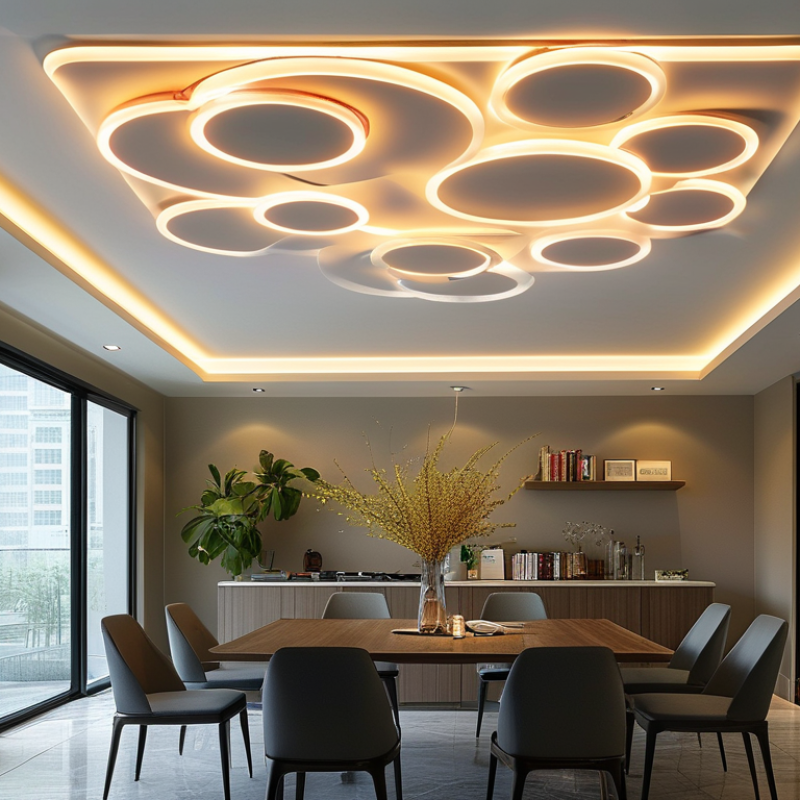
The ten best LED ceiling lights depend on each room’s function, ceiling height, and local electrical standards. For living rooms, choose a wide diffuser with warm white light around 2700–3000K. Bedrooms need gentle, low-glare lighting that supports evening relaxation. Kitchens benefit from brighter output, accurate color rendering, and easy cleaning. A dining room suits a dimmable fixture, especially above a central table. Measure twice.
Bathrooms require suitable moisture protection, such as an appropriate IP rating for the installation zone. Hallways work well with slim, evenly spaced lights that prevent harsh shadows. Home offices need neutral white light and low flicker for longer screen sessions. Nurseries should use soft illumination, covered LEDs, and simple controls. Garages need higher brightness, durable housings, and dependable performance in cooler conditions. Utility rooms benefit from practical, broad illumination rather than decorative shapes.
Global buyers should confirm voltage, frequency, mounting hardware, and certification requirements before ordering. A compatible dimmer is not always included. Check the product specifications carefully. Color temperature can also appear different across homes and regions. I once underestimated how strongly a glossy kitchen counter reflected cool light. The room looked brighter, but less comfortable. That small oversight shows why room surfaces, user habits, and fixture placement matter as much as lumen numbers. Reliable choices balance safety, visual comfort, maintenance, and long-term energy use.
10 Best LED Ceiling Lights for Global Buyers - The 10 Best LED Ceiling Lights for Different Room Types
| No. | Recommended Room Type | Ideal Light Format | Typical Power | Light Output | Suggested Coverage | Color Temperature | Color Rendering | Protection Rating | Expected Life | Key Selection Benefit |
| 1 | Living Room | Flush-mount ambient panel | 24–36 W | 2,400–3,600 lm | 18–30 m² | 2700–4000 K adjustable | CRI 80+ | IP20 | 25,000–50,000 hours | Balanced general lighting with flexible ambience. |
| 2 | Bedroom | Dimmable slim ceiling light | 18–24 W | 1,500–2,400 lm | 10–18 m² | 2700–3000 K | CRI 80+ | IP20 | 25,000–50,000 hours | Warm, low-glare illumination suited to relaxation. |
| 3 | Kitchen | High-output surface-mounted panel | 30–45 W | 3,000–4,500 lm | 15–25 m² | 3500–5000 K | CRI 80–90 | IP44 recommended | 30,000–50,000 hours | Bright, practical light for food preparation and cleaning. |
| 4 | Bathroom | Moisture-resistant ceiling fixture | 18–30 W | 1,800–3,000 lm | 6–15 m² | 3500–4000 K | CRI 80+ | IP44–IP54 | 25,000–50,000 hours | Designed to handle humidity when installed in suitable zones. |
| 5 | Home Office | Low-glare panel with diffuser | 24–36 W | 2,400–3,600 lm | 10–20 m² | 3500–5000 K | CRI 90 preferred | IP20 | 30,000–50,000 hours | Improves visual comfort for reading and screen-based work. |
| 6 | Dining Room | Decorative dimmable ceiling pendant | 18–30 W | 1,500–3,000 lm | 10–18 m² | 2700–3000 K | CRI 80–90 | IP20 | 25,000–50,000 hours | Creates warm visual comfort above dining surfaces. |
| 7 | Hallway | Compact flush-mount fixture | 10–18 W | 800–1,800 lm | 4–10 m² | 3000–4000 K | CRI 80+ | IP20 | 25,000–50,000 hours | Space-saving design with even directional guidance. |
| 8 | Children’s Room | Flicker-reduced diffused ceiling light | 18–30 W | 1,800–3,000 lm | 10–18 m² | 2700–4000 K adjustable | CRI 80+ | IP20 | 25,000–50,000 hours | Soft diffusion, dimming, and concealed light sources improve comfort. |
| 9 | Garage or Utility Room | High-output utility ceiling fixture | 36–60 W | 4,000–7,000 lm | 20–35 m² | 4000–6500 K | CRI 80+ | IP44–IP65 | 30,000–50,000 hours | High brightness and improved durability for task-focused areas. |
| 10 | Covered Outdoor Area | Weather-resistant bulkhead ceiling light | 15–30 W | 1,200–3,000 lm | 8–20 m² | 3000–5000 K | CRI 80+ | IP65 recommended | 30,000–50,000 hours | Sealed construction helps protect against dust and water jets. |
Note: Recommended specifications are general purchasing guidelines. Actual brightness depends on ceiling height, room layout, surface reflectance, local electrical standards, and installation conditions.
Installation, Compatibility, and Energy Efficiency Considerations
10 Best LED Ceiling Lights for Global Buyers
Installation should shape your shortlist, not only brightness or appearance. Measure the ceiling box, mounting plate, and available cable length before ordering. In my installation checks, a few millimeters can prevent a secure fit. Use a qualified electrician when wiring is unfamiliar. Ceiling height matters too. Flush fixtures suit low rooms, while adjustable models help direct light across larger spaces.
Compatibility requires careful reading. Select a fixture rated for your local voltage and frequency, such as 100–240V and 50/60Hz for broader markets. Check dimmer compatibility, grounding requirements, and connector standards. A light may physically fit yet fail with an existing dimmer. Look for recognized safety testing and clear installation instructions. Local electrical rules still apply, even when the product carries international markings.
Energy efficiency is measurable, but marketing claims need context. The U.S. Department of Energy reports that LED products use at least 75% less energy and last up to 25 times longer than incandescent lighting. ENERGY STAR guidance also emphasizes lumen output, rather than wattage, for fair comparisons. A 1,600-lumen ceiling light may replace a brighter-looking but inefficient lamp. Choose high lumens per watt, low standby power, and replaceable components where possible. I would not trust a “lifetime” claim without test conditions. Real rooms include heat, dust, and voltage variation.
How to Choose the Right LED Ceiling Light for Your Market
10 Best LED Ceiling Lights for Global Buyers
Choosing the right LED ceiling light starts with the target market, not appearance. Measure room size, ceiling height, and local voltage first. A compact bedroom may need 1,000–1,500 lumens, while a large retail space may require several fixtures. The U.S. Department of Energy reports that LED products can use at least 75% less energy and last up to 25 times longer than incandescent lighting. These figures matter when buyers compare lifetime operating costs.
Check color temperature carefully. Warm white, around 2700–3000K, suits bedrooms and hospitality spaces. Neutral white, near 3500–4000K, works well in kitchens and offices. For product displays, request a color rendering index of 80 or higher. Healthcare and retail buyers may need stronger color accuracy. Do not trust brightness alone. Ask for measured lumens, beam angle, power factor, flicker performance, and lumen maintenance data.
Safety requirements vary by destination. Confirm voltage, frequency, ingress protection, fire ratings, and recognized market certifications before placing a bulk order. The International Energy Agency continues to identify efficient lighting as an important energy-saving opportunity across buildings. Still, efficiency claims can hide weak thermal design. Touch the housing after testing. Excessive heat may shorten service life. A perfect fixture rarely exists. I would compare warranty terms, spare-driver availability, packaging strength, and installation time, then test samples in the actual market.