


2026 Top Types of Disposable Plastic Cups for Global Buyers
Choosing the right Disposable Plastic Cups in 2026 requires more than comparing price and clarity. Global buyers must examine drink temperature, filling speed, transport distance, storage conditions, and end-of-life options. PET cups provide strong transparency for iced coffee, juice, and bubble tea. PP cups tolerate warmer beverages and repeated handling better. rPET can reduce virgin plastic use, but supply quality may vary between regions. Compostable cups sound attractive, yet they require suitable industrial composting systems. That detail is often missed.
Packaging recycling specialist Edward Kosior has stated, “If we can’t recycle it, we shouldn’t make it.” His point remains useful, although cup recycling is not always simple. Adhesive labels, sleeves, lids, pigments, and leftover drinks can reduce recovery quality. Buyers should request resin identification, food-contact documentation, migration test results, and verified recycled-content evidence. They should also confirm whether local facilities actually accept the selected material.
This guide compares the top types of Disposable Plastic Cups for global purchasing teams. It considers practical performance, appearance, customization, cost, and responsible sourcing. Some choices will look perfect on paper. They may fail during shipping or filling. Therefore, sampling remains essential. Test the cup with real beverages, real sealing equipment, and realistic warehouse temperatures. A low-cost cup can become expensive when leaks, cracking, or rejected shipments appear. Requirements also differ across markets, so buyers should verify current regional rules before placing orders.
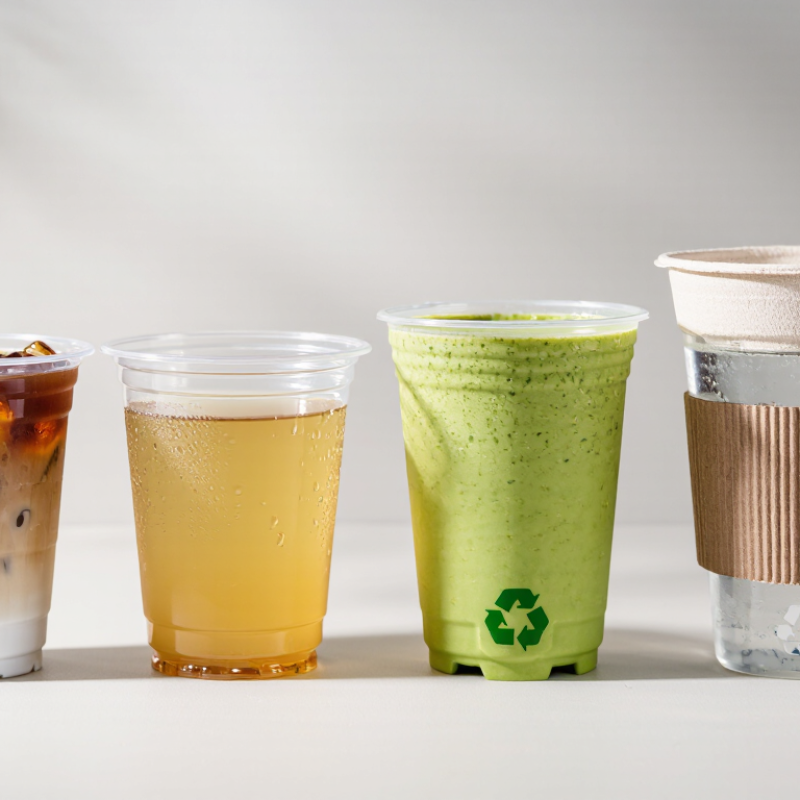
What Are Disposable Plastic Cups and Why Do Global Buyers Use Them?
Disposable plastic cups are single-use containers designed for serving cold drinks, samples, desserts, and takeaway beverages. Common materials include PET, PP, and polystyrene. Each material performs differently. PET offers clear visibility, while PP handles moderate heat better. Cup walls may be thin, rigid, smooth, or textured, depending on the intended use.
In practical sourcing work, buyers usually check capacity, rim diameter, lid fit, leakage resistance, and carton strength. A 12-ounce cup may suit iced coffee, but it may not fit the same lid as a 16-ounce version. Small mistakes can affect thousands of units. Global buyers choose disposable cups because they support fast service and consistent portion control. They also reduce washing labor in busy cafés, food stalls, offices, and outdoor events. Lightweight cartons lower handling effort and often simplify shipping.
Hygiene is another important reason. Unused cups arrive sealed and ready for direct service. However, disposable does not automatically mean sustainable. Recycling access differs between countries and even between cities. Buyers should review material labels, local waste systems, and packaging requirements before ordering. Some cups feel sturdy but create unnecessary material use. Others save plastic but may collapse under ice and pressure. That trade-off deserves honest testing with real drinks, real lids, and real transport conditions.
2026 Top Types of Disposable Plastic Cups for Global Buyers
Disposable plastic cups are single-use beverage containers commonly made from PET, PP, PS, or EPS. Global buyers select them according to beverage temperature, clarity, strength, insulation, capacity, and packaging requirements.
The chart shows representative commercial capacities commonly specified for each cup type. Actual sizes vary by market, supplier, wall thickness, and application.
Which Materials Are Used in Disposable Plastic Cup Production?
Disposable plastic cups are commonly made from PET, PP, PS, or bio-based PLA. Each material performs differently during filling, transport, and use. PET offers strong clarity, making it suitable for iced coffee, juice, and cold drinks. Its smooth surface also supports clean printing and easy visual inspection.
PP handles warmer liquids better than PET in many cup designs. It is lightweight, flexible, and less likely to crack during stacking. However, heat resistance depends on wall thickness, additives, and forming conditions. PS provides a rigid, economical option, but its use and recycling access vary between markets. Buyers should check local requirements before placing large orders.
PLA is made from renewable plant-based feedstocks and can look similar to conventional plastic. It is not automatically compostable everywhere. Industrial composting conditions may be required, while ordinary recycling systems may reject it. Recycled PET can reduce virgin material use, but food-contact approval and traceability must be verified.
Important checks include resin documentation, migration testing, rim strength, sealing performance, and temperature limits. A clear cup is not always a safer cup. A “green” material may also create sorting problems.
I would compare the full supply chain, not only the material name. Small production samples often reveal warping, odor, or poor lid fit before shipment. That step is easy to skip. It should not be.
What Are the Main Types of Disposable Plastic Cups in 2026?
The main disposable plastic cup types in 2026 are PET, PP, PS, PLA, and HDPE. PET cups are clear, rigid, and highly suitable for iced tea, smoothies, and layered drinks. PP cups tolerate higher temperatures and flex without cracking, making them practical for warm beverages and takeaway lids. PS remains lightweight and economical, but its role is declining as buyer requirements and market access rules change. HDPE cups are less transparent, yet they offer toughness for water stations and institutional service.
According to Grand View Research, the global plastic cups market was valued at about USD 14.9 billion in 2023, with continued growth expected through 2030. The report also identifies foodservice and beverage applications as major demand areas. PLA cups attract buyers seeking bio-based materials, but they usually require controlled industrial composting. They may not break down in ordinary outdoor conditions. That detail is often missed.
The United Nations Environment Programme reports that humanity produces over 430 million tonnes of plastic annually, with about two-thirds becoming short-lived products. Cup selection therefore needs more than a material label. Check wall thickness, rim strength, sealing performance, temperature range, and local recovery systems. A clear cup is not automatically recyclable everywhere. Definitions vary, and that is a real weakness in many market comparisons.
How Should Buyers Compare Cup Sizes, Features, and Applications?
Global buyers should compare disposable plastic cups by use case, not appearance alone. Grand View Research valued the global disposable cups market at about USD 13.4 billion in 2023. It also forecasts a 6.1% compound annual growth rate through 2030. This growth increases pressure to select the right size and material.
Cup capacity affects cost, handling, and customer expectations. Small 4–8 ounce cups suit tastings, sauces, and short beverage servings. Standard 12–16 ounce cups work well for water, juice, and takeaway drinks. Larger 20–32 ounce cups support iced beverages but need stronger walls and compatible lids.
A 12-ounce cup may look economical, yet poor stacking can raise warehouse costs. Measure the actual fill line. Nominal volume can mislead.
Material choice should follow temperature and application. PET offers clear presentation for cold drinks, while PP generally performs better with warmer contents and repeated handling.
For high-volume service, check rim strength, leak resistance, lid fit, nesting efficiency, and carton protection. Smithers’ packaging outlook reports continued demand for lighter cups and improved resource efficiency, but lightweight designs can feel unstable. That trade-off deserves testing.
Request samples, fill them at operating temperature, and simulate transport before ordering. Buyers should also verify food-contact documentation for each destination market, because accepted materials and labeling requirements may differ.
Cost per cup is incomplete without freight, rejected units, storage space, and application performance.
What Standards and Suppliers Should Global Buyers Consider?
For global buyers, choosing disposable plastic cups in 2026 requires more than comparing price and wall thickness. Cup types may include PET, PP, and recycled-content options, but each material needs suitable food-contact evidence. Buyers should request migration test reports, material specifications, and production batch records. A clear paper trail matters.
Requirements differ across markets. Confirm the destination country’s rules for food-contact plastics, labeling, recycling claims, and restricted substances. Ask suppliers whether testing covers the actual cup, lid, ink, and coating. Testing only the raw resin may leave important risks unseen. Check reports from competent, independent laboratories. Certificates can expire.
Supplier evaluation should include factory audits, quality-control procedures, and traceability from resin to shipment. Request samples from normal production, not only carefully selected samples. Test stacking strength, leak resistance, temperature performance, and odor after filling. A cup that survives a showroom test may fail during a humid ocean shipment.
Ask for a corrective-action process when defects appear. Reliable suppliers explain causes, deadlines, and verification steps without hiding uncomfortable details. Review their capacity during seasonal demand, packaging protection, and backup production plans. Smaller orders still deserve documented controls. This is often overlooked. Buyers should also question vague claims such as “eco-friendly” unless measurable evidence supports them. Supplier transparency is useful, but independent verification remains necessary.
| Disposable Cup Type | Typical Resin or Material | Common Capacity Range | Typical Appearance and Features | Temperature and Application Profile | Widely Used Identification or Compliance References | Recycling or End-of-Life Considerations | Key Supplier Checks for Global Buyers |
|---|---|---|---|---|---|---|---|
| Clear Beverage Cup Rigid transparent cup | Polyethylene terephthalate (PET) Resin identification code: 1 | Approximately 200–700 ml Common commercial sizes include 300 ml, 400 ml, 500 ml and 700 ml | High clarity, glossy surface, good stiffness and strong product visibility. Often supplied with flat lids, dome lids or straw openings. | Mainly intended for cold drinks such as water, juice, soft drinks, iced coffee and milk tea. PET cups should not be treated as suitable for hot liquids unless the specific product has been tested and approved for that use. | EU Regulation 10/2011 EC 1935/2004 EC 2023/2006 GMP U.S. 21 CFR 177.1630 | PET is technically recyclable where collection and reprocessing infrastructure accepts PET cups. Cup recycling rates may be reduced by food residue, labels, lids, sleeves and local sorting rules. | Request food-contact declarations, migration-test reports, resin specifications, wall-thickness tolerance, lid compatibility, leak testing and confirmation that recycled content is legally permitted for the intended market. |
| Hot and Cold Service Cup Semi-rigid or rigid cup | Polypropylene (PP) Resin identification code: 5 | Approximately 180–600 ml Common commercial sizes include 250 ml, 350 ml, 400 ml and 500 ml | Available in translucent, opaque or printed versions. Good impact resistance and comparatively higher heat resistance than PET, PS and PLA in many cup designs. | Suitable for cold beverages and, when specifically designed and tested, selected hot beverages. Actual performance depends on grade, wall thickness, lid design, filling temperature and handling conditions. | EU Regulation 10/2011 EC 1935/2004 EC 2023/2006 GMP U.S. 21 CFR 177.1520 | PP recycling is available in some markets but collection access varies considerably. Local acceptance of PP cups should be verified before making recyclability claims. | Ask for food-contact compliance by destination country, heat-resistance test conditions, top-load and drop-test results, dimensional consistency, lid fit, odor testing and evidence that colorants and additives are permitted. |
| Foam or Lightweight Cold Cup Rigid or foamed cup | Polystyrene (PS), including expanded polystyrene in some applications Resin identification code: 6 | Approximately 180–500 ml Larger sizes may be available for institutional foodservice | Lightweight, low-cost and available in clear or opaque forms. Foam versions provide insulation but are more fragile and bulky during transport. | Generally used for cold drinks or limited-temperature foodservice applications. PS is not normally selected for high-temperature beverage service unless the specific product is expressly qualified for that condition. | EU Regulation 10/2011 EC 1935/2004 EC 2023/2006 GMP U.S. 21 CFR 177.1640 | Recycling access for PS cups is limited in many regions. Some jurisdictions restrict or prohibit certain expanded or single-use PS foodservice products, so import and sales regulations must be checked. | Confirm destination-country restrictions, food-contact documentation, breakage rate, nesting efficiency, packaging volume, static-control performance and whether the product is rigid PS or expanded PS. |
| Compostable-Positioned Clear Cup Bio-based or partially bio-based plastic cup | Polylactic acid (PLA) Compostable plastic; resin identification may vary by market and product marking system | Approximately 250–700 ml Common commercial sizes include 300 ml, 400 ml, 500 ml and 700 ml | Clear, glossy appearance similar to conventional clear beverage cups. Frequently paired with compostable lids and suitable for cold-drink presentation. | Primarily intended for cold beverages. PLA generally has limited heat resistance and should not be used for hot liquids unless the supplier provides product-specific qualification data. | EN 13432 ASTM D6400 ASTM D6868 where applicable EU Regulation 10/2011 where applicable | Industrial compostability is not the same as home compostability or biodegradability in the natural environment. The required industrial composting facilities may not be available in the buyer’s target market. | Request a valid certificate for the finished cup, not only the raw resin; verify disintegration, biodegradation, ecotoxicity and heavy-metal requirements; confirm composting conditions and permitted environmental claims in the destination market. |
| Double-Wall Insulated Plastic Cup Reusable-style disposable cup | Usually PP or PET, sometimes with a separate insulating layer or air gap | Approximately 300–700 ml Common commercial sizes include 400 ml, 500 ml and 600 ml | Two-layer construction helps reduce exterior condensation and improves handling comfort. May include snap-on lids, sleeves or textured gripping areas. | Commonly used for iced beverages, takeaway drinks and event service. Heat suitability depends on the polymer and construction; a double wall alone does not prove hot-drink safety. | EU Regulation 10/2011 EC 1935/2004 EC 2023/2006 GMP Applicable U.S. FDA food-contact rules | Multi-material or bonded constructions can make sorting and recycling more difficult. Buyers should determine whether the cup, lid and insulating components can be separated. | Check layer composition, sealing quality, condensation performance, compression resistance, cup-to-lid fit, nesting and shipping volume, plus the compliance status of every material in contact with food. |
| Vending and Portion-Control Cup Small-volume thin-wall cup | Commonly PP, PET or PS, depending on beverage temperature and machine design | Approximately 90–250 ml Typical sizes include 120 ml, 150 ml, 180 ml and 200 ml | Lightweight, stackable and designed for automated dispensing. May include calibrated volume markings, reinforced rims or machine-compatible dimensions. | Used for water, tasting portions, samples, desserts and vending applications. The correct material depends on the beverage temperature, dispensing speed and equipment geometry. | EU Regulation 10/2011 EC 1935/2004 EC 2023/2006 GMP Destination-market food-contact rules | Small cups may be difficult to recover economically because of their low weight and potential contamination. Buyers should avoid unsupported claims about universal recyclability. | Provide the vending-machine specification, required rim diameter, stack height, dispensing tolerance, cup weight, static behavior, leak rate, dimensional inspection plan and packaging cleanliness requirements. |
Article Source:
Let's Work Together
The most innovative products come from the most innovative people - and for over 55 years our team has been propelled by curiosity and a steadfast dedication to inventing and creating the best foam formulations for our customers.